The long read
The science of starring
Being in the story may help a child pay attention and talk more: promising, not proven. What counts is what the child does on the page, and what you do as you read.
The long read, 14 minutes. Short on time? Read it in five minutes.
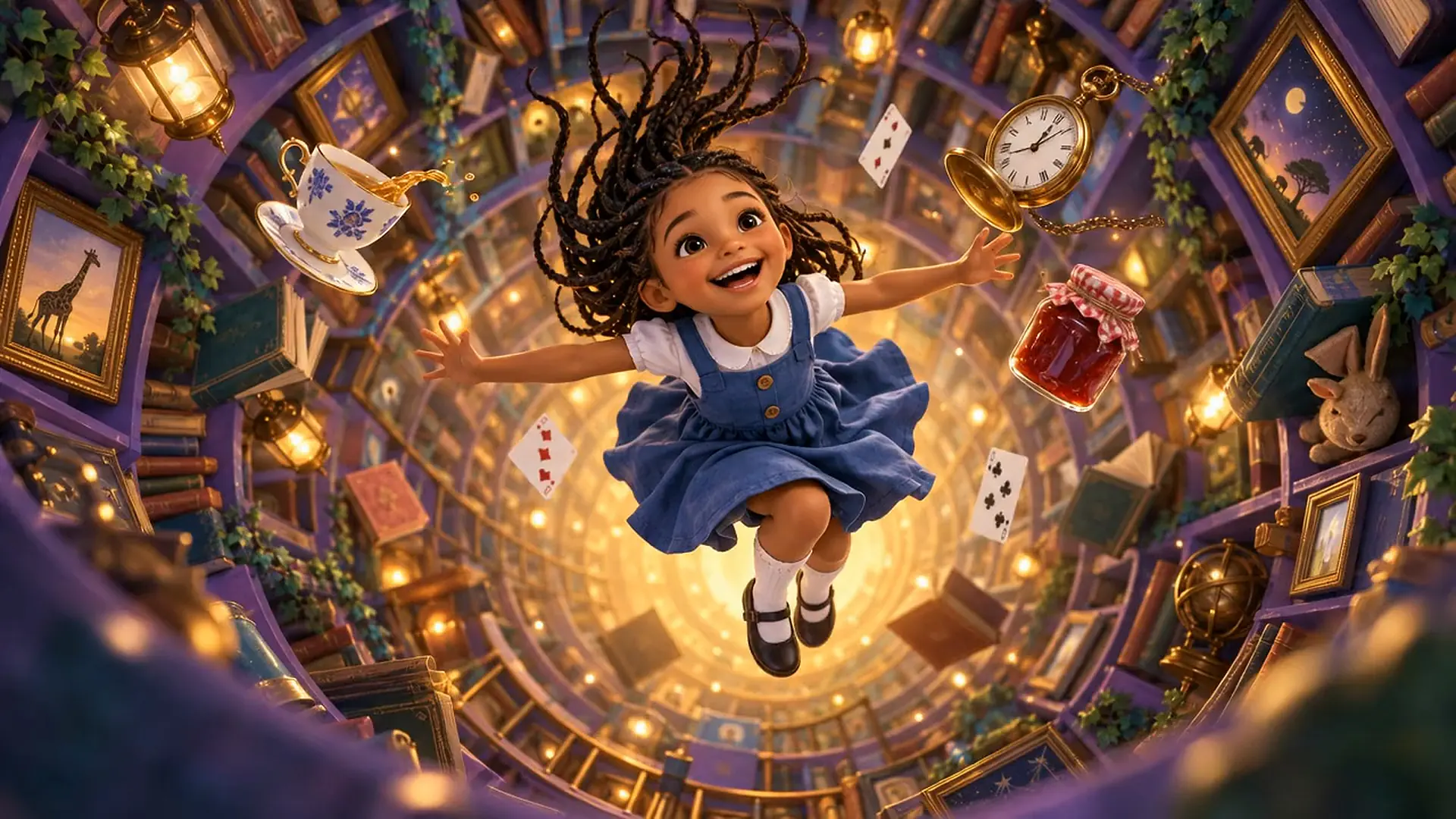
Personalised books, which put a child’s name and face into the story, are a promising way to help children learn, not a proven one. A child’s own name catches their attention from babyhood, and small studies suggest children learn new words better and talk more on pages about them. How it’s done matters: the child in the story should be doing the thing to be learned, not just decorating the page. The better-tested habits work with any book: ask questions as you read, let them remember for themselves, and read the same story again.
The research begins with a name. In a 1995 study, Denise Mandel, Peter Jusczyk and David Pisoni played recordings of four names to 24 American babies of about four and a half months: each baby’s own name and three others. The babies listened longer to their own, even when another name had the same rhythm of strong and weak syllables: the first evidence that babies so young recognise the sound of their name.1
In short
- From five months, a baby’s own name works like a spotlight on whatever comes next.
- Preschoolers remember things linked to themselves a little better when they are part of the action, not just pictured beside it.
- Studies of personalised books are few and small: promising for words and talk, mixed in the one randomised trial we found.
- Better tested: questions as you read, letting a child remember, and the same story again, especially with talk. Enjoyment is linked with progress too.
What does a baby know about their own name?
Less than the headlines suggest. Mandel’s babies were recognising a familiar pattern of sound, measured by how long they listened, which is not the same as knowing that the name means “me”.1
Even that depends on the room. In Rochelle Newman’s 2005 study, five-month-olds picked their name out of a babble of other voices only when it was 10 decibels louder than the chatter. At 5 decibels, nine-month-olds still failed; 13-month-olds succeeded.2 For the smallest listeners, a quiet room and a close voice help.
What a name does is more interesting than what it means. In a German study in 2010, 30 five-month-olds each heard their own name on some trials and a stranger’s on others, then saw a picture of an object. Their brain responses showed more attention to the objects that followed their own name.3 The name works like a spotlight: this next thing is for you. The study measured attention, not what the babies learned.
By six months a familiar word is also a foothold: babies recognised a new word that came straight after their own name in a sentence, but not one after an unfamiliar name.4 “Mommy” worked too, so the help comes from familiarity, whoever the name belongs to.
Do children remember more when it’s about them?
Adults remember information better when they have linked it to themselves: the self-reference effect. In 2011 Josephine Ross and her colleagues found it in seven experiments with 456 children from 17 Scottish nurseries. Three- and four-year-olds remembered more of the objects they had acted on themselves, the ones shown with their own photograph or described with “I”, and the ones they owned. In their words, “it seems that in typical development, ‘I’ is primed to remember ‘me.’”5
The effects were modest (in one experiment, 3.4 objects recognised against 3.1),5 and in 2014 a UK team found the same pattern in three studies of four- to six-year-olds and their own photos.6
Then comes the result that ought to shape every personalised book. When Ross simply showed a child’s photo beside the objects, four-year-olds remembered more of the objects linked to a stranger’s photo. The researchers suspected the children’s own photographs “sometimes distracted from, rather than drew attention toward, task stimuli.” When the next experiment placed each object on the photo, as though the child were doing the action, the advantage came back, at least for three-year-olds.5
A face that decorates the page can compete with the lesson. A face that does the lesson can help carry it.
A name gives a head start on letters, though not on sounds. In 1998 Rebecca Treiman and Victor Broderick found that young children in the US and Australia knew the name of the first letter of their own name better than other letters, and printed it better, but had no advantage for that letter’s sound.9 The sound still has to be taught.
Grade R takes that next step: in Home Language, children learn to give the beginning sound of their own name. It is the skill Down the Rabbit Hole practises, where every door in Wonderland opens to a sound and the great gate opens to theirs. There’s more on how reading begins in first sounds and phonics.
What do the studies of personalised books actually show?
There are fewer than you might think, and they are small. In the first controlled study, published in 2014, Natalia Kucirkova and her colleagues in the UK read 18 children, average age three years and ten months, a picture book with personalised and ordinary sections, each containing new words. After a second reading a week later, the children knew the words from the personalised sections significantly better.10
Personalisation also seems to change the talk. Summaries of a second study by the same team, with three-year-olds, report that children spoke more during the personalised pages, much of it about themselves.11 More talk is good for language, but “that’s me” is not yet talk about the story.
A 2021 study of 26 British mothers sharing a personalised book on screen with their three- and four-year-olds pointed to the parent’s role in “expanding beyond children’s focus on self during shared reading.”12 The name gets them in. The adult takes them further.
The newest study, in 2025, involved older children: 96 primary-school pupils read a story whose hero either shared their first name or didn’t. Those who met themselves in the story did better on questions asking them to apply what they’d read.13 That gain was in using the story; from the abstract, we can’t tell whether they also remembered more of it.
The one randomised trial we found is more sobering. In Chile, low-income families of toddlers were given either a personalised book or an ordinary one. According to a summary of the trial, the families with the personalised book were more likely to say their child had a favourite book. But on parents’ reports, the children given the ordinary book showed more interest in books, and with only one story tested, nobody can separate the personalisation from the story.14
A small Korean study in 2024 matters to anyone making books with AI, as we do: 15 children aged three to six learned new words as well from AI-generated stories as from traditional ones, and no better.15 That fits how we see AI: a way to make a book, not a way to teach.
We looked for a large, independent trial showing that personalised books improve reading or maths, and found none. Nor could we find a study of books where the child’s face is drawn into the illustrations, or one in South Africa or an African language. If you read that personalised books are proven to boost learning, the honest reply is: not yet.
Does fantasy help children learn, or get in the way?
Every story we retell is a fantasy, so this matters to us, and the research gives two answers, both true.
First, children carry lessons out of stories about real people more readily. In three experiments in 2009 with children aged three and a half to six, Richert and colleagues found that they more often used a story’s solution on a real problem when its characters were real people.16
Yet fantasy isn’t simply a cost. When 49 US children aged three to six watched problem-solving clips from educational cartoons, solutions transferred best when the fantasy was moderate, or when it came at the moment that mattered for solving the problem.17
And in low-income US preschools, 154 children learned 20 new words over two weeks through books and play about either farms or dragons. Both groups understood the words equally well, but the dragon group made bigger gains in using them.18 That study didn’t test whether the words travelled into everyday life.
Talking animals have been tested too. In a Canadian study, preschoolers who heard a sharing story with human characters gave away more stickers afterwards; those who heard the identical story told with raccoons gave away fewer.19 It is one study, but it matters to us: Jakkals and Wolf is a sharing story with talking animals. In ours, a human child, the reader, shows the animals how to share fairly. We think that may get round the raccoon problem, but we can’t yet show it.
A 2018 review pulls the threads together: fantastical settings make it harder to carry a solution into real life, and interactive extras can distract, though “each feature has been tested only a handful of times in a handful of contexts.” The reviewers suggest an adult who asks the child to explain, links the story to real life, and talks about what is real and what is pretend.21
Our own reading, a step beyond the reviewers’, is that the magic should be the frame and the thing being learned should be real: a great wind can carry a child to Oz, but the stars they count there should be real stars. The case for the old tales themselves is in why fairy tales still matter.
Why do children want the same story again and again?
We found no study of why children ask for the same book, but a well-known experiment suggests that granting the request helps. In 2011 Horst and colleagues read three-year-olds storybooks three times over a week: either the same story each time, or three different stories containing the same new words, the same number of times. The first group learned the words and kept them. The second “failed to learn any of the new words.”22
Sleep may help too. In a small British study titled, irresistibly, “Goodnight book”, three-year-olds who napped after hearing stories remembered new words better, hours, a day and a week later, than children who stayed awake.23 These were naps, and children napped or not by habit rather than at random, so a night’s sleep after a bedtime story may do the same, but this study didn’t test it.
Asking a child to remember beats telling them again. British three- and four-year-olds learning the names of six toy pigs roughly doubled what they recalled when they practised remembering at growing intervals, while a reward made no significant difference.24 None of these studies used a bedtime book, or spaced practice over days, but they are why each of our books ends with a small check worth trying again a week later.
A 2018 meta-analysis adds a caution. Pooling 38 studies of 2,455 children, Flack and colleagues found that children learned on average 45% of the new words they met in shared reading. Asking questions as you read added about 1.2 words, and who did the reading made no difference. The extra benefit of rereading, across studies, was small and uncertain: “the true effect could be 0.”25 The fair summary: rereading helps, especially with talk alongside it.
What does it do to a child to be the hero?
In 2017 White and colleagues gave 180 four- and six-year-olds a dull task for ten minutes, with a fun video game nearby. Children who pretended to be a hard-working character such as Batman kept at it longest. Next came those who thought of themselves in the third person (“Is Lerato working hard?”), and last, those who asked, “Am I working hard?”26 Being the hero of a book is a different thing from pretending to be Batman. We suspect it works in a similar way, but we found no study that has looked.
Words about who a child is are slippery. Asking children to “be a helper” rather than “to help” got more help in one lab study and less, after setbacks, in another,27, 28 and “Let’s do science” kept young girls at new science games longer than “Let’s be scientists”.29 What the helper studies suggest for everyday life is in sharing and taking turns.
Where does joy come in?
Start with a Rubik’s cube. In two studies published in 2017, Dore, Smith and Lillard played 7- and 10-year-olds a two-and-a-half-minute recorded story, either about a professor or about a quite different character. Afterwards the children who had met the professor spent longer with a Rubik’s cube, and rated themselves as more professor-like: smart, good at teaching. The pull was strongest in the children who had been most absorbed in the story.30
It was a short recording, not a picture book, the children were older than most of ours, and the effect was short-term. Still, it hints that how absorbed a child is in a story matters.
On a bigger scale, something like it shows up in reading for pleasure. In 2000, the OECD’s first PISA study found that 15-year-olds whose parents had the lowest-status jobs, but who were keen, engaged readers, averaged 540 points: nearly the average of top-performing Finland, and more than poorly engaged readers with parents in higher-status jobs. The OECD concluded that engaging students in reading “may be one of the most effective ways to leverage social change.”31 It is a correlation, about teenagers in 32 countries (not including South Africa), and the popular version, that enjoying reading matters more than family background, goes further than the report does.
A British cohort born in 1970 points the same way. Among 3,583 children followed from 10 to 16, those who read for pleasure made more progress in vocabulary, and to a lesser extent in maths, than similar children who didn’t, and reading for pleasure was more strongly linked to that progress than their parents’ education was. Playing a musical instrument wasn’t linked to progress at all.32
Interest matters early too: in a US study of 61 low-income families, children’s keenness on reading helped explain the link between how well their parents read with them and how many words the children understood.33 All correlations, but a good reason to build the learning into the pleasure of the story instead of bolting it on at the end.
What this means for how our books are made
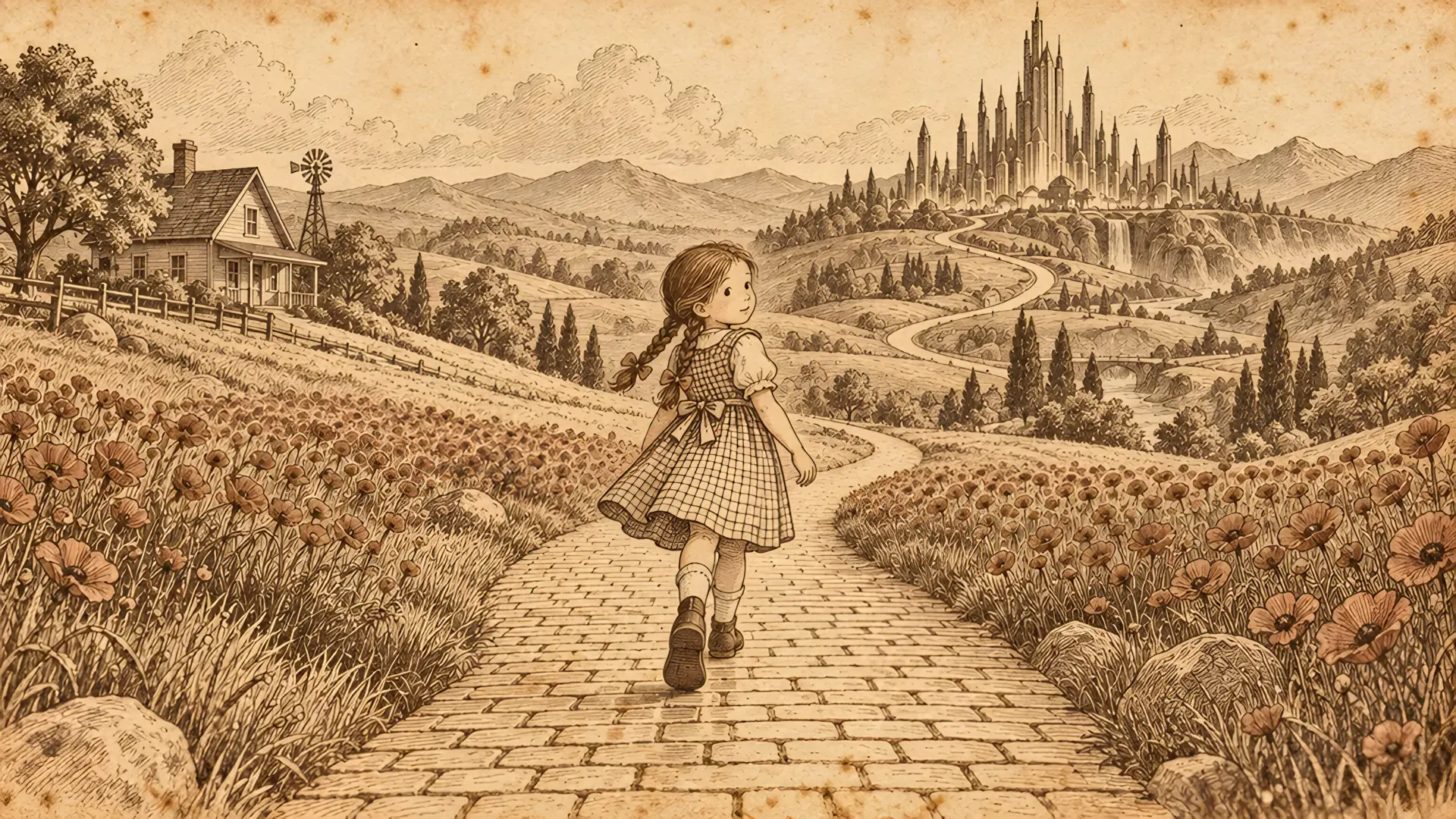
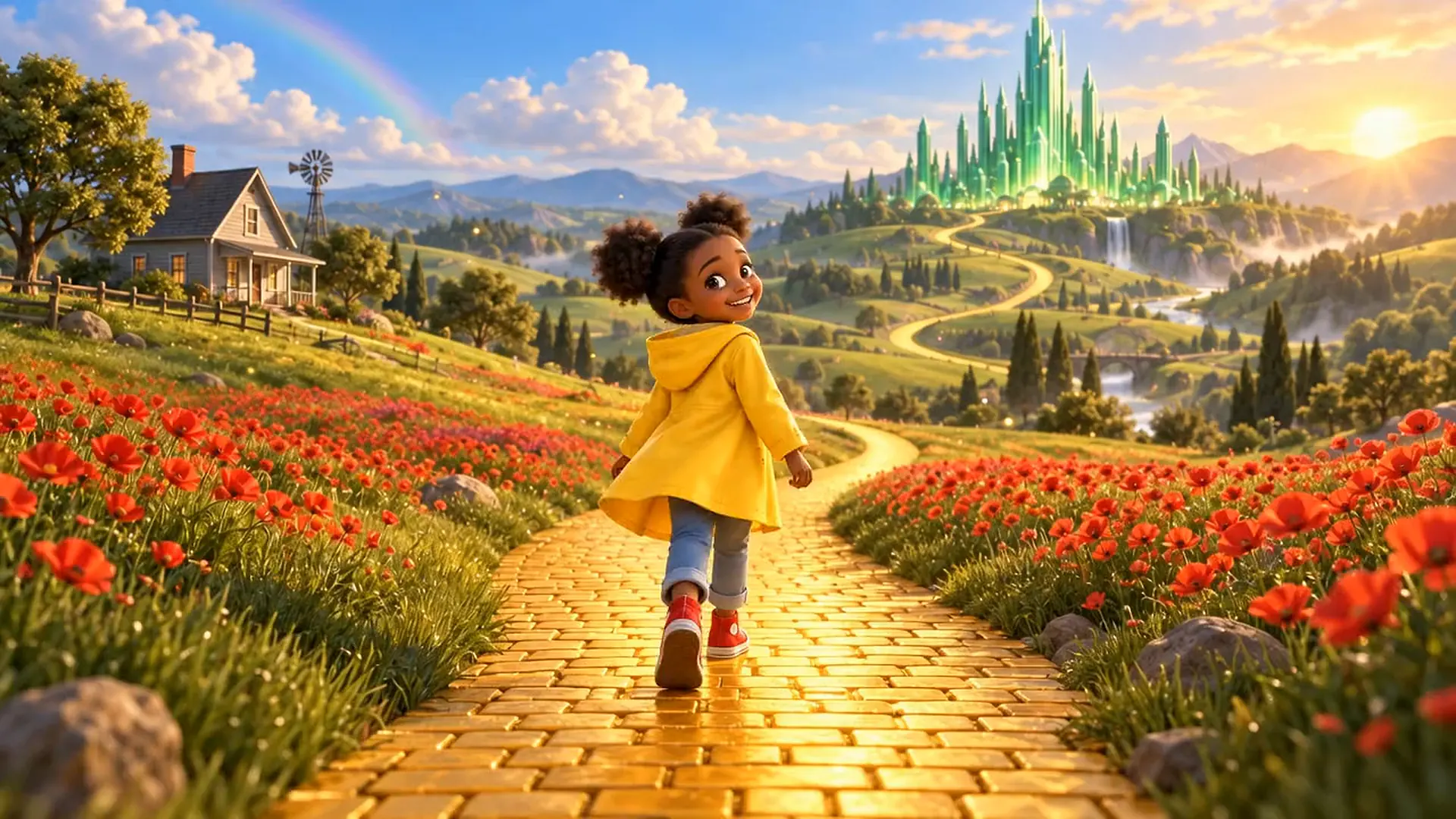
Each of our books practises one skill, chosen for the child’s age with South Africa’s curriculum as our reference: CAPS from Grade R, and the early-learning framework before it. In The Golden Road the skill is counting, and the counting is the plot: from three spins of the little grey house to eleven green towers, each count moves the story on, and after seven drops of oil the Tin Woodman can move. The child in the story does the counting, which puts their face in the action: in Ross’s memory game, that is where a child’s own picture helped instead of distracting, at least for three-year-olds.5 And each count has a page to itself, an idea borrowed from a word-learning study in which three-and-a-half-year-olds learned fewer new words when a spread made them search two pictures at once.34
At the back, a page for you suggests questions to ask as you read, because the conversation is where the learning travels. The approach, though not our page, has been tested here: in Khayelitsha, carers who joined eight weekly group sessions on book sharing reported that their babies understood and said more words.35 A page of questions is a far lighter dose (across 19 trials, less than an hour of training did little),36 so think of it as a start; our piece on reading aloud has the rest.
Every format also comes with an animated trailer, for sharing the excitement, and you can add an animated version of the book. One small study is worth knowing when you choose how to read it: 27 children of about five heard stories as audio, as an illustrated book and as an animation, and understood the animated one least well, though it always came last.37
CAPS is our reference; the Department of Basic Education doesn’t endorse us.
What we don’t claim
We don’t claim our books make children cleverer, or that being the hero is a lesson in itself. A story with a lesson in it is not a lesson learned: in a 2026 randomised study from the University of Bern, a storybook written to help 147 five- to seven-year-olds judge how sure they were of their answers made no overall difference, over two sessions, compared with a counting book.38 Shared reading has limits too: in a 2019 meta-analysis, its benefit was negligible in studies where the comparison group got another engaging activity instead.39
What we do claim is smaller, and we think more useful. A child who finds themselves in a story may pay closer attention, as babies do to their own name, and early, small studies suggest they talk more. That is where the better-tested techniques do their work: questions as you read, remembering for themselves, the same story again, a real thing to learn inside a wonderful story, and a grown-up enjoying it too.
Nobody has tested a Story for Me book yet, which is why everything in one leans on something that has been tested. The method on our home page shows how we choose each skill, with sources.
Sources
- Mandel, D. R., Jusczyk, P. W., & Pisoni, D. B. (1995). Infants’ recognition of the sound patterns of their own names. Psychological Science, 6(5), 314–317. doi.org/10.1111/j.1467-9280.1995.tb00517.x
- Newman, R. S. (2005). The cocktail party effect in infants revisited: Listening to one’s name in noise. Developmental Psychology, 41(2), 352–362. doi.org/10.1037/0012-1649.41.2.352
- Parise, E., Friederici, A. D., & Striano, T. (2010). “Did you call me?” 5-month-old infants own name guides their attention. PLoS ONE, 5(12), e14208. doi.org/10.1371/journal.pone.0014208
- Bortfeld, H., Morgan, J. L., Golinkoff, R. M., & Rathbun, K. (2005). Mommy and me: Familiar names help launch babies into speech-stream segmentation. Psychological Science, 16(4), 298–304. doi.org/10.1111/j.0956-7976.2005.01531.x
- Ross, J., Anderson, J. R., & Campbell, R. N. (2011). I remember me: Mnemonic self-reference effects in preschool children. Monographs of the Society for Research in Child Development, 76(3), Serial No. 300. doi.org/10.1111/j.1540-5834.2011.00613.x
- Cunningham, S. J., Brebner, J. L., Quinn, F., & Turk, D. J. (2014). The self-reference effect on memory in early childhood. Child Development, 85(2), 808–823. doi.org/10.1111/cdev.12144
- Nuttin, J. M. (1985). Narcissism beyond Gestalt and awareness: The name letter effect. European Journal of Social Psychology, 15(3), 353–361. doi.org/10.1002/ejsp.2420150309
- Hoorens, V., Nuttin, J. M., Herman, I. E., & Pavakanun, U. (1990). Mastery pleasure versus mere ownership: A quasi-experimental cross-cultural and cross-alphabetical test of the name letter effect. European Journal of Social Psychology, 20(3), 181–205. doi.org/10.1002/ejsp.2420200302
- Treiman, R., & Broderick, V. (1998). What’s in a name: Children’s knowledge about the letters in their own names. Journal of Experimental Child Psychology, 70(2), 97–116. doi.org/10.1006/jecp.1998.2448
- Kucirkova, N., Messer, D., & Sheehy, K. (2014). Reading personalized books with preschool children enhances their word acquisition. First Language, 34(3), 227–243. doi.org/10.1177/0142723714534221
- Kucirkova, N., Messer, D., & Sheehy, K. (2014). The effects of personalisation on young children’s spontaneous speech during shared book reading. Journal of Pragmatics, 71, 45–55. doi.org/10.1016/j.pragma.2014.07.007
- Kucirkova, N., Gattis, M., Spargo, T. P., Seisdedos de Vega, B., & Flewitt, R. (2021). An empirical investigation of parent-child shared reading of digital personalized books. International Journal of Educational Research, 105, 101710. doi.org/10.1016/j.ijer.2020.101710
- Lindhaus, M., Ehlert, M., & Dutke, S. (2025). Personalizing text by using readers’ names: Effects on reading comprehension and social agency. European Journal of Psychology of Education, 40(3), Article 91. doi.org/10.1007/s10212-025-00991-1
- Mendive, S., Placencio-Castro, M., Strasser, K., Kucirkova, N., Pozo-Tapia, F., & Domínguez, P. (2023). Impacts of a personalized book giveaway intervention in low-SES households. Early Childhood Research Quarterly, 63, 169–180. doi.org/10.1016/j.ecresq.2022.12.008. The findings as summarised by Reach Out and Read: reachoutandread.org
- Cho, J.-E., & Yim, D. (2024). The impact of personalized book reading activities using AI-generated stories on vocabulary acquisition in preschool children. Communication Sciences & Disorders, 29(4), 686–702. doi.org/10.12963/csd.240041
- Richert, R. A., Shawber, A. B., Hoffman, R. E., & Taylor, M. (2009). Learning from fantasy and real characters in preschool and kindergarten. Journal of Cognition and Development, 10(1–2), 41–66. doi.org/10.1080/15248370902966594
- Richert, R. A., & Schlesinger, M. A. (2017). The role of fantasy–reality distinctions in preschoolers’ learning from educational video. Infant and Child Development, 26(4), e2009. doi.org/10.1002/icd.2009
- Weisberg, D. S., Ilgaz, H., Hirsh-Pasek, K., Golinkoff, R. M., Nicolopoulou, A., & Dickinson, D. K. (2015). Shovels and swords: How realistic and fantastical themes affect children’s word learning. Cognitive Development, 35, 1–14. doi.org/10.1016/j.cogdev.2014.11.001
- Larsen, N. E., Lee, K., & Ganea, P. A. (2018). Do storybooks with anthropomorphized animal characters promote prosocial behaviors in young children? Developmental Science, 21(3), e12590. doi.org/10.1111/desc.12590
- Ganea, P. A., Canfield, C. F., Simons-Ghafari, K., & Chou, T. (2014). Do cavies talk? The effect of anthropomorphic picture books on children’s knowledge about animals. Frontiers in Psychology, 5, 283. doi.org/10.3389/fpsyg.2014.00283
- Strouse, G. A., Nyhout, A., & Ganea, P. A. (2018). The role of book features in young children’s transfer of information from picture books to real-world contexts. Frontiers in Psychology, 9, 50. doi.org/10.3389/fpsyg.2018.00050
- Horst, J. S., Parsons, K. L., & Bryan, N. M. (2011). Get the story straight: Contextual repetition promotes word learning from storybooks. Frontiers in Psychology, 2, 17. doi.org/10.3389/fpsyg.2011.00017
- Williams, S. E., & Horst, J. S. (2014). Goodnight book: Sleep consolidation improves word learning via storybooks. Frontiers in Psychology, 5, 184. doi.org/10.3389/fpsyg.2014.00184
- Fritz, C. O., Morris, P. E., Nolan, D., & Singleton, J. (2007). Expanding retrieval practice: An effective aid to preschool children’s learning. Quarterly Journal of Experimental Psychology, 60(7), 991–1004. doi.org/10.1080/17470210600823595
- Flack, Z. M., Field, A. P., & Horst, J. S. (2018). The effects of shared storybook reading on word learning: A meta-analysis. Developmental Psychology, 54(7), 1334–1346. doi.org/10.1037/dev0000512
- White, R. E., Prager, E. O., Schaefer, C., Kross, E., Duckworth, A. L., & Carlson, S. M. (2017). The “Batman effect”: Improving perseverance in young children. Child Development, 88(5), 1563–1571. doi.org/10.1111/cdev.12695
- Bryan, C. J., Master, A., & Walton, G. M. (2014). “Helping” versus “being a helper”: Invoking the self to increase helping in young children. Child Development, 85(5), 1836–1842. doi.org/10.1111/cdev.12244
- Foster-Hanson, E., Cimpian, A., Leshin, R. A., & Rhodes, M. (2020). Asking children to “be helpers” can backfire after setbacks. Child Development, 91(1), 236–248. doi.org/10.1111/cdev.13147
- Rhodes, M., Leslie, S.-J., Yee, K. M., & Saunders, K. (2019). Subtle linguistic cues increase girls’ engagement in science. Psychological Science, 30(3), 455–466. doi.org/10.1177/0956797618823670
- Dore, R. A., Smith, E. D., & Lillard, A. S. (2017). Children adopt the traits of characters in a narrative. Child Development Research, 2017, 6838079. doi.org/10.1155/2017/6838079
- OECD (2002). Reading for Change: Performance and Engagement across Countries. Results from PISA 2000. Paris: OECD Publishing. oecd.org (PDF)
- Sullivan, A., & Brown, M. (2015). Reading for pleasure and progress in vocabulary and mathematics. British Educational Research Journal, 41(6), 971–991. doi.org/10.1002/berj.3180
- Malin, J. L., Cabrera, N. J., & Rowe, M. L. (2014). Low-income minority mothers’ and fathers’ reading and children’s interest: Longitudinal contributions to children’s receptive vocabulary skills. Early Childhood Research Quarterly, 29(4), 425–432. doi.org/10.1016/j.ecresq.2014.04.010
- Flack, Z. M., & Horst, J. S. (2018). Two sides to every story: Children learn words better from one storybook page at a time. Infant and Child Development, 27(1), e2047. doi.org/10.1002/icd.2047
- Vally, Z., Murray, L., Tomlinson, M., & Cooper, P. J. (2015). The impact of dialogic book-sharing training on infant language and attention: A randomized controlled trial in a deprived South African community. Journal of Child Psychology and Psychiatry, 56(8), 865–873. doi.org/10.1111/jcpp.12352
- Dowdall, N., Melendez-Torres, G. J., Murray, L., Gardner, F., Hartford, L., & Cooper, P. J. (2020). Shared picture book reading interventions for child language development: A systematic review and meta-analysis. Child Development, 91(2), e383–e399. doi.org/10.1111/cdev.13225
- Hutton, J. S., Dudley, J., Horowitz-Kraus, T., DeWitt, T., & Holland, S. K. (2019). Functional connectivity of attention, visual, and language networks during audio, illustrated, and animated stories in preschool-age children. Brain Connectivity, 9(7), 580–592. doi.org/10.1089/brain.2019.0679
- Fritz, J. S., Scalvedi, B., Kolloff, K., Ger, E., & Roebers, C. M. (2026). Learning from storybooks: Using shared book reading to target 5- to 7-year-olds’ metacognitive monitoring. Early Education and Development, 37(5), 1215–1237. doi.org/10.1080/10409289.2026.2641476
- Noble, C. H., Sala, G., Peter, M., Lingwood, J., Rowland, C. F., Gobet, F. R., & Pine, J. M. (2019). The impact of shared book reading on children’s language skills: A meta-analysis. Educational Research Review, 28, 100290. doi.org/10.1016/j.edurev.2019.100290