A South African folk tale
Jakkals, Wolf and the cleverest trick of all
Long before the comic strips, Khoekhoe storytellers told of a jackal who always got the most. Here is how the tales reached Afrikaans, who was written out of their history, and a retelling in which your child changes the game.

The Wolf of the Jakkals and Wolf stories is not a wolf: in old Afrikaans, “wolf” meant a hyena.1 Jakkals, though, is every bit as sly as you remember. In Jakkals and Wolf, our personalised retelling of the South African folk tale, your child walks into the Karoo and talks him round to sharing and taking turns.
Where do the Jakkals and Wolf stories come from?
Mostly from the Khoekhoe. In 1864 the linguist Wilhelm Bleek published a collection in London of 42 numbered fables, legends and tales, almost all of them Khoekhoe, and thirteen of them about Jackal.2 Bleek didn’t collect them himself. Most are translated from manuscripts that the Rhenish missionary G. Krönlein, at Beerseba in Great Namaqualand, took down in the Nama language from Nama storytellers, whose names were not recorded.1, 2
In Afrikaans, the key collector was G. R. von Wielligh, a surveyor and writer who heard the tales from Khoi (Khoekhoe) and San storytellers: in Namaqualand in 1870, and from 1880 to 1883 in the Calvinia district, on the edge of the Karoo where our book is set. He wrote, in van Niekerk’s translation, that “fables and stories” were told around the fireside at night, and he preferred older narrators. He published the tales as a book in 1907 and then, much expanded, in four volumes between 1917 and 1922 that are still in print as Dierestories. Every later Afrikaans Jakkals en Wolf book draws on him to some extent.1
Scholars have argued about the tales’ origins ever since Bleek named his book after Reynard the Fox, medieval Europe’s trickster. The Afrikaans scholars Stander and Bosman held that the Middle Dutch Reynard poem was a particularly strong, even definitive, influence, though even they conceded there are few similarities with Von Wielligh’s tales.1
Jacomien van Niekerk, in a 2018 study, argues that Afrikaans literary history took over these Khoi tales and wrote their tellers out; a 2008 edition of Von Wielligh even dropped the subtitle naming the Khoi as his narrators.1 The fair summary: the jackal stories came into Afrikaans from Khoekhoe storytellers, and scholars still debate how much of Europe mixed in.
From 1870, Bleek turned to a different people. With his sister-in-law Lucy Lloyd he recorded the language and stories of ǀxam San teachers who lived with them in Cape Town, some 14,000 pages by UCT’s count.3 That archive, and the ǀxam motto on South Africa’s coat of arms, are in our essay on why fairy tales still matter.
What happens in the old tales?
Jackal wins by trickery, and Hyena pays. In “Fish-Stealing”, Jackal sees a wagon coming back from the sea laden with fish, runs ahead and lies in the road as if dead. “Here is a fine kaross for your wife!” the leader calls to the driver, and Jackal is tossed aboard, where he throws the fish into the road all night.
Then he talks Hyena into trying the same trick. She is thrashed, and hobbles off saying, “What a pity… that I have not such a handsome skin as you!”2
“Cloud-Eating” is sharper still. Jackal tells Hyena, “My sister, as I am going to divide with thee, catch me well”, and later lets her fall from a cloud: “Since that day, it is said, that the Hyena’s left hind foot is shorter and smaller than the right one.”2 The old tales don’t preach sharing, and this one is about a broken promise to share. Our book turns the tradition around, on purpose.
Why is Wolf really a hyena?
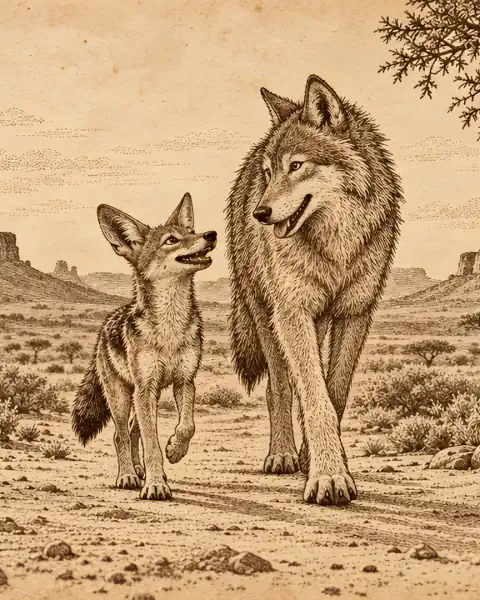
Because the word moved. Old Afrikaans gave the Dutch “wolf” to the hyena and “tier” (tiger) to the leopard; the linguist Raidt calls both remnants of Dutch with a shift in meaning. The illustrations of the early Von Wielligh texts, van Niekerk writes, “clearly show a spotted hyena”, and Bleek’s English translations already say Hyena.1
The European wolf came later: the artist T. O. Honiball drew a European jackal or fox and a European wolf, and picture books were still drawing one as recently as 2016.1 Our Wolf is a big, shaggy spotted hyena with gentle eyes, closer to those early illustrations.
Jakkals in the comics, on LP and at bedtime
By 1940, Afrikaans children knew the pair so well that when the editor Truida Pohl asked Honiball to create a comic strip for Die Jongspan, the children’s supplement of Huisgenoot, she suggested Jakkals and Wolf. The very first strips were based on stories Honiball’s nanny had told him, and the strip ran from 1942 to 1986: forty-four years.1
In the 1980s, Ans Niehaus wrote “Wolf en Jakkals” stories that her husband, Dana Niehaus, recorded on LP, and parents and grandparents simply made up their own at bedtime. At least half the Niehaus material resembles Von Wielligh’s, van Niekerk notes, “though Von Wielligh and the Khoi are never mentioned”.1 If an Ouma or Oupa in your family still does Wolf’s voice, ask where they first heard it.
What happens in our Jakkals and Wolf?
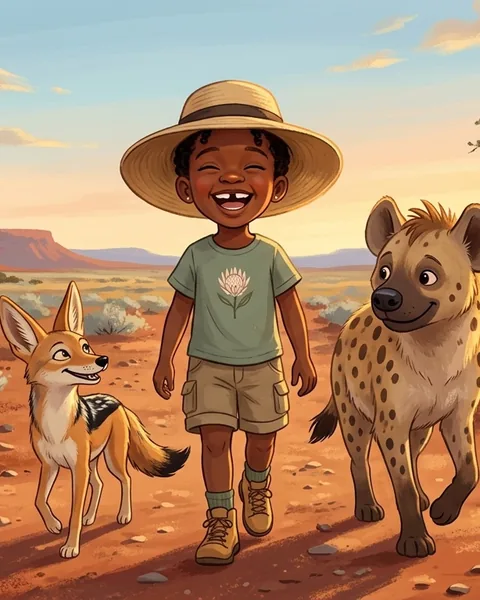
Our retelling begins where the old ones do: “Long ago, when the Karoo was young, clever Jakkals played tricks on big, shaggy old Wolf. Jakkals always got the most, and Wolf always got the least.” Then a new friend comes walking over the koppie in a wide straw sun hat: your child or, in our sample, Thandi.
Jakkals opens with the trick Bleek’s Jackal used on the fish wagon: he plays dead, and while kind old Wolf runs for water, the melon disappears. The book asks the question it keeps asking, “How does Wolf feel now?”, and Thandi brings in a rule small enough to say out loud. Six figs become three and three: “One for you, one for me: fair share!”
Then the book tests the rule the way real life does. There is one spade, so they take turns, Wolf first, and dig until water bubbles up into the dry dam (a dassie comes to drink too). One tyre swing means ten swings each, and Jakkals counts Wolf’s while he waits. As the book says, “Waiting is hard, even for clever jackals.”
Sharing comes next. Five rusks for two leave one over, so Thandi snaps it in half. When Jakkals tries a last trick, telling Wolf the moon in the dam is a cheese, Thandi laughs, “That’s not cheese. That’s the moon!”, and adds, “The moon is for everyone.” Jakkals says sorry and then, all by himself, counts ten dried peaches into two piles of five.
Near the end, lying on the koppie under the Southern Cross, they take turns to find stars, and Jakkals has a new motto: “Sharing,” he says, “is the cleverest trick of all.” Along the way your child counts figs, swings, rusks and peaches, and the tricks stay funny, never cruel: nobody is thrashed, and nobody falls from a cloud.
What does it practise?
Sharing and taking turns, chosen with South Africa’s curriculum as a reference. In Grade 1, CAPS Life Skills lists “Waiting my turn” and “Sharing” among the manners and responsibilities children learn in the third term, with a note to the teacher: “Use role play.” And Grade 2 Life Skills moves on to “Dealing positively with conflict”, which is what happens on the night of the moon and the cheese.4
Turn-taking starts earlier, in talk: Grade R Home Language lists “Listens without interrupting, taking turns to speak”.5 Before school, the national framework hopes children approaching Grade R will “work with others, take turns and share”.6 Our pages on Grade 1 and Grade 2 have more.
The book is a kind of role play on paper: your child brings in the fair-share rule and calls the turns, until Jakkals shares without being asked. No one has studied the book itself, which is brand new; what it borrows, like asking how Wolf feels, is the well-studied part.
CAPS is our reference; the Department of Basic Education doesn’t endorse us.
When do children learn to share?
Later than we hope. In lab games played for sweets, most three- and four-year-olds hold on to a sweet when sharing it costs them one, and far more seven- and eight-year-olds give it up.7 So reminders are normal, and no sign of an unkind child. The numbers, the studies from other countries and more games are in sharing and taking turns: the science of fairness.
Who is it for?
We wrote Jakkals and Wolf for children of about three to seven, and for brothers and sisters in particular. Oumas and Oupas who grew up with Jakkals will know the territory (see gifts from grandparents and godparents). It comes in English, isiZulu, isiXhosa, Afrikaans and Sesotho, and its dedication is a rule to live by: “For Thandi, who knows that the best things are even better shared.”
Sources
- van Niekerk, J. (2018). Afrikaans stories of Jackal and Hyena: Oral and written traditions. Tydskrif vir Letterkunde, 55(3), 80–95. doi.org/10.17159/2309-9070/tvl.v.55i3.5511
- Bleek, W. H. I. (1864). Reynard the Fox in South Africa (its subtitle uses a slur and is left out here). London: Trübner and Co. A collection of Khoekhoe (Nama) fables and tales. Preface, dedication and contents; fables 7 (“Cloud-Eating”) and 8 (“Fish-Stealing”). Project Gutenberg eBook #73413. gutenberg.org/ebooks/73413
- University of Cape Town News (4 April 2003). Jewel in UCT’s crown to be digitised for world’s scholars. news.uct.ac.za
- Department of Basic Education (2011). Curriculum and Assessment Policy Statement (CAPS): Life Skills, Foundation Phase, Grades R–3. Pretoria: DBE. Grade 1 Term 3 (p. 32), Grade 2 Term 1 (p. 42) and Term 4 (p. 45). education.gov.za (PDF)
- Department of Basic Education (2011). Curriculum and Assessment Policy Statement (CAPS): English Home Language, Foundation Phase, Grades R–3. Pretoria: DBE. Grade R Term 2 (p. 37). education.gov.za (PDF)
- Department of Basic Education (2015). The South African National Curriculum Framework for Children from Birth to Four. Pretoria: DBE. Identity and belonging, Towards Grade R (p. 37). education.gov.za (PDF)
- Fehr, E., Bernhard, H., & Rockenbach, B. (2008). Egalitarianism in young children. Nature, 454(7208), 1079–1083. doi.org/10.1038/nature07155