Life Skills
One for you, one for me
Toddlers help before they can talk, but sharing a sweet of their own takes years. What the studies of fairness found, what the curriculum asks, and games for taking turns.
When Fehr and his colleagues played sharing games with 229 Swiss children aged 3 to 8, the currency was sweets: Smarties, jelly babies or fizzers. When sharing meant giving away a sweet of their own, only 8.7% of the three- and four-year-olds shared. By seven and eight, 45% did.1 Fairness grows a great deal between three and eight, and laboratory studies hint at what helps it along. Taking turns, the other skill on this page, starts in conversation.
In short
- In a Swiss study, sharing that cost a child a sweet was rare at three and four, and much more common by seven and eight, so expect to give reminders.
- Toddlers help adults readily from about 18 months. In one small study, a material reward for helping made them help less later; praise didn’t.
- Three-year-olds share far more equally when they have earned something together.
- CAPS asks for turn-taking in conversation from Grade R, and lists “Waiting my turn” and “Sharing” in Grade 1 Life Skills.
- At home: do a job together, then share the spoils, and thank them rather than paying them.
When do children learn to share?
Later than we hope. In the Swiss study, 78% of the five- and six-year-olds still kept the sweet when sharing would cost them one. When fairness was free, things looked different: by seven and eight, about four in five chose the equal split. Children were also fairer to their own group than to outsiders, a pull the researchers called parochialism.1
The groups were small (23 children aged three and four played the key game) and all Swiss. When another team re-checked the data in 2024, they found a variable coded the wrong way round; once it was fixed, every test reproduced except one that had nothing to do with the main findings.2 So the analysis holds up. But “children can’t share until they’re seven” goes too far, because much younger children do something just as telling.
Do toddlers help before they share?
Yes, if sharing means giving up something of their own. Helping shows up early, and readily. In 2006, Warneken and Tomasello showed that children as young as 18 months will help an adult who drops something or can’t open a cupboard, without being asked and without a reward. Three young chimpanzees did something similar, though less reliably.3
In a follow-up, 20-month-olds who were given a material reward for helping (a little cube they could use to make a toy jingle) later helped less than toddlers who got praise or nothing at all.5 It was one small study in Germany, and praise didn’t reduce helping, so the lesson is a narrow one: thank a child for helping, and don’t pay for it with a sweet. The study was about helping; carrying it over to sharing is our own guess.
Words matter too, in a more complicated way. In a lab study of 149 children aged 3 to 6, being invited to “be a helper” got more help than being asked “to help”.6 But a later study of 139 four- and five-year-olds found that after setbacks, children asked to be helpers had more negative attitudes and helped less than those asked to help.7 A fair reading of both: invite them in with who they could be, and keep them going with what they are doing.
What makes sharing fairer?
Working for it together. In a 2011 study, three-year-olds shared a reward far more equally when they had earned it by collaborating with a partner than when it simply fell into their laps, or when each had worked alone side by side. Chimpanzees shared just as often whether they had collaborated or not.8 The task was a lab apparatus, nothing like baking or the garden. Still, we suspect the idea travels (the study doesn’t show it): a job done together could make a fair split feel natural.
“It’s not fair on me” comes first; “it’s not fair on you” comes later, and not everywhere.
The two sides of fairness also grow at different speeds. In a study of 866 pairs of children aged 4 to 15 in seven societies (Canada, India, Mexico, Peru, Senegal, Uganda and the USA), children everywhere came to object when a peer got more than they did. Objecting when they got more themselves appeared in only three of the societies, the USA, Canada and Uganda, and later. South Africa wasn’t in the study.9 “It’s not fair on me” comes first; “it’s not fair on you” comes later, and not everywhere.
Sharing is maths, too. In South Africa’s curriculum, children meet fractions by sharing things out: “Learners develop fraction concept through solving problems involving the sharing of physical quantities”, and in the Foundation Phase they “are not expected to read or write fraction symbols”. One of the Grade R problems has children sharing cookies among teddies “so that they all get the same number of cookies. How many cookies can each teddy get?”10
How do children learn to take turns?
In conversation first. In the second term of Grade R, CAPS Home Language asks children to listen “without interrupting, taking turns to speak”.11 It is a bigger skill than it sounds. In a US study of 36 children aged 4 to 6, those who had more back-and-forth turns of conversation with adults at home showed more activity in Broca’s area, a key language region of the brain, while listening to stories, whatever their family’s income and however many words they heard.12 It is a small, correlational study, but it is a good argument for asking, waiting and letting them answer.
Then in play, and in manners. The curriculum builds it up year by year.13, 11, 14
| When | In the curriculum’s words |
|---|---|
| Towards Grade R (from about four) | “work with others, take turns and share” |
| Grade R, Term 2 | “Listens without interrupting, taking turns to speak” |
| Grade 1, Term 3 | “Waiting my turn”; “Sharing”; “Showing kindness” |
| Grade 2, Term 1 | “Dealing positively with conflict - include self-esteem and bullying” |
The Grade 1 list sits in a two-hour topic on manners and responsibilities, and the note to teachers begins “Use role play”, which is what children do anyway when they play shop or house.14 There is more on each year in Grade 1 in South Africa: what CAPS expects and Grade 2 CAPS.
CAPS is our reference; the Department of Basic Education doesn’t endorse us. The quotations keep the DBE’s own wording and punctuation.
What happens in Jakkals and Wolf?
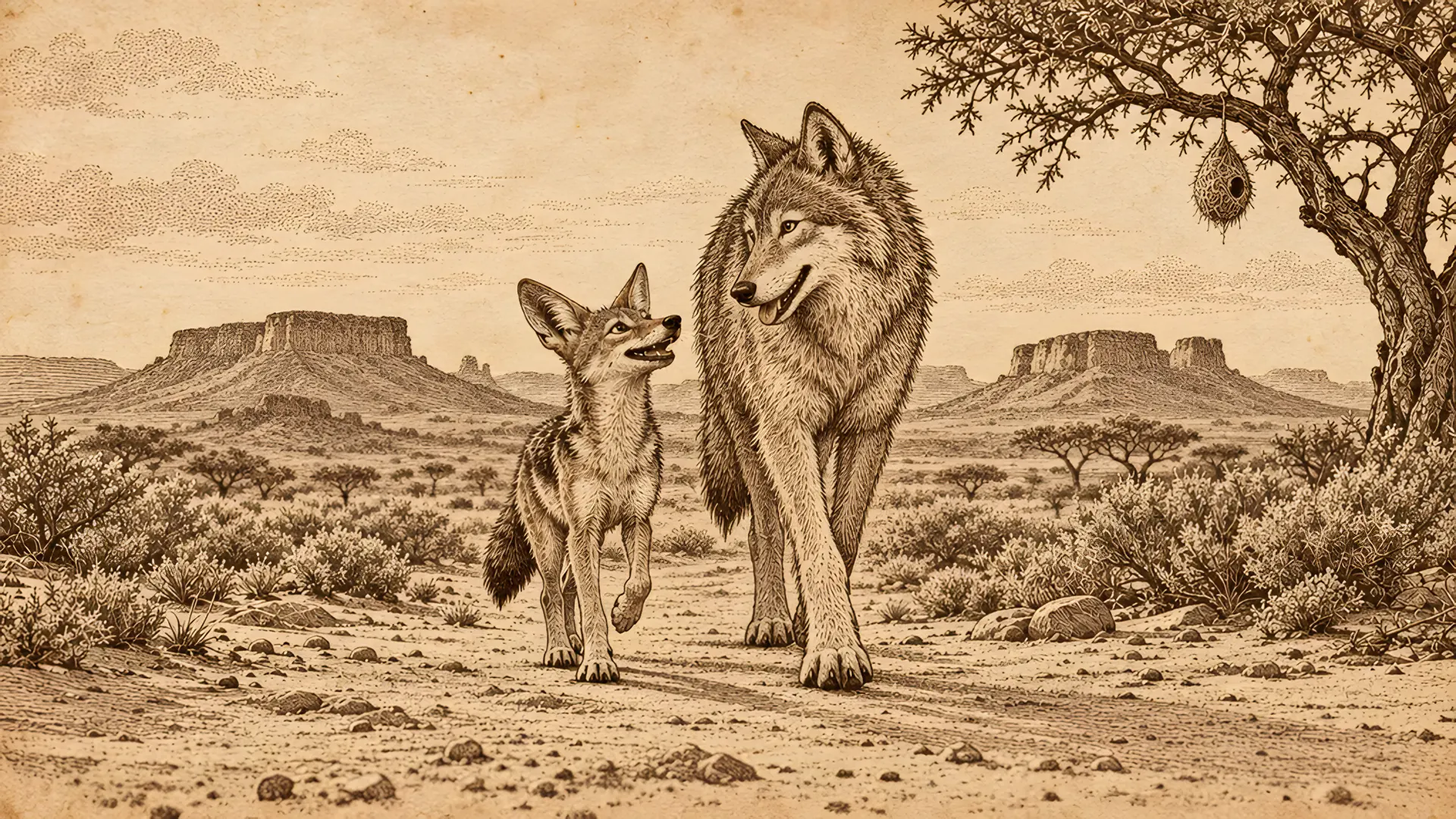
Our Jakkals and Wolf starts with the old Karoo trickster, who always gets the most, while Wolf, drawn in our book as a big, friendly spotted hyena, always gets the least. Then your child comes walking over the koppie. Under the fig tree, six figs become three each, by the Fair Share rule: “One for you, one for me”. There is only one spade, so they dig in turns, “Wolf first”.
At the tyre swing it is ten swings each. “Let’s count while we wait!” says your child, so Jakkals counts Wolf’s swings, and the book admits, “Waiting is hard, even for clever jackals.” Five rusks leave one over, and your child snaps it in half. When Jakkals tries to send Wolf after a cheese that is really the moon in the dam, your child says, “The moon is for everyone.”
By the end, the trickster has learnt the trick: he tips out his secret bag of ten dried peaches and counts, “all by himself”, five for Wolf and five for himself. “Sharing,” he says, “is the cleverest trick of all.”

The book asks again and again, “How does Wolf feel now?”, so sharing and naming feelings come together. One Canadian study suggests why a human hero may matter: preschoolers gave away more stickers after a sharing story with human characters, and fewer after the same story told with raccoons.15 What that and other studies of fantasy mean for books like ours is in the science of starring.
In our fable the animals talk, as the raccoons did, but the one who shows what fair looks like is a child: your own. Whether that makes a difference is an open question, and a book as new as ours has no study to settle it.
Games for sharing and taking turns
Expect slow progress and lots of reminders: in the Swiss games, most children under seven kept the sweet when sharing would cost them one, and that is ordinary.
Squabbles over turns are part of growing up. If they often turn into hurting, or you think your child is being bullied or left out, talk to the teacher.
Sources
- Fehr, E., Bernhard, H., & Rockenbach, B. (2008). Egalitarianism in young children. Nature, 454(7208), 1079–1083. doi.org/10.1038/nature07155
- Clift, G., Beaudry, J., Leung, S., & Kaufman, J. (2024). Verification report: Egalitarianism in young children. Infant and Child Development, 33(4), e2505. doi.org/10.1002/icd.2505
- Warneken, F., & Tomasello, M. (2006). Altruistic helping in human infants and young chimpanzees. Science, 311(5765), 1301–1303. doi.org/10.1126/science.1121448
- Murray, L., De Pascalis, L., Tomlinson, M., Vally, Z., Dadomo, H., MacLachlan, B., Woodward, C., & Cooper, P. J. (2016). Randomized controlled trial of a book-sharing intervention in a deprived South African community: Effects on carer-infant interactions, and their relation to infant cognitive and socioemotional outcome. Journal of Child Psychology and Psychiatry, 57(12), 1370–1379. doi.org/10.1111/jcpp.12605; the later trial: Dowdall, N., et al. (2021). Child Development, 92(6), 2252–2267. doi.org/10.1111/cdev.13619
- Warneken, F., & Tomasello, M. (2008). Extrinsic rewards undermine altruistic tendencies in 20-month-olds. Developmental Psychology, 44(6), 1785–1788. doi.org/10.1037/a0013860
- Bryan, C. J., Master, A., & Walton, G. M. (2014). “Helping” versus “being a helper”: Invoking the self to increase helping in young children. Child Development, 85(5), 1836–1842. doi.org/10.1111/cdev.12244
- Foster-Hanson, E., Cimpian, A., Leshin, R. A., & Rhodes, M. (2020). Asking children to “be helpers” can backfire after setbacks. Child Development, 91(1), 236–248. doi.org/10.1111/cdev.13147
- Hamann, K., Warneken, F., Greenberg, J. R., & Tomasello, M. (2011). Collaboration encourages equal sharing in children but not in chimpanzees. Nature, 476(7360), 328–331. doi.org/10.1038/nature10278
- Blake, P. R., McAuliffe, K., Corbit, J., Callaghan, T. C., Barry, O., Bowie, A., … Warneken, F. (2015). The ontogeny of fairness in seven societies. Nature, 528(7581), 258–261. doi.org/10.1038/nature15703
- Department of Basic Education (2011). Curriculum and Assessment Policy Statement (CAPS): Mathematics, Grade R. Pretoria: DBE. Table 2.1 (p. 9) and Grade R problem types (p. 48). education.gov.za (PDF)
- Department of Basic Education (2011). Curriculum and Assessment Policy Statement (CAPS): English Home Language, Foundation Phase, Grades R–3. Pretoria: DBE. Grade R Term 2 (p. 37). education.gov.za (PDF)
- Romeo, R. R., Leonard, J. A., Robinson, S. T., West, M. R., Mackey, A. P., Rowe, M. L., & Gabrieli, J. D. E. (2018). Beyond the 30-million-word gap: Children’s conversational exposure is associated with language-related brain function. Psychological Science, 29(5), 700–710. doi.org/10.1177/0956797617742725
- Department of Basic Education (2015). The South African National Curriculum Framework for Children from Birth to Four. Pretoria: DBE. Identity and belonging, Towards Grade R (p. 37). education.gov.za (PDF)
- Department of Basic Education (2011). Curriculum and Assessment Policy Statement (CAPS): Life Skills, Foundation Phase, Grades R–3. Pretoria: DBE. Grade 1 Term 3 (p. 32), Grade 2 Term 1 (p. 42). education.gov.za (PDF)
- Larsen, N. E., Lee, K., & Ganea, P. A. (2018). Do storybooks with anthropomorphized animal characters promote prosocial behaviors in young children? Developmental Science, 21(3), e12590. doi.org/10.1111/desc.12590