Alice’s Adventures in Wonderland, 1865
Down the Rabbit Hole: Alice, and the doors that open to a sound
Carroll’s Alice began as a story told on a boat and a book made by hand for one child. Ours ends at a gate that opens to the first sound of your child’s name.
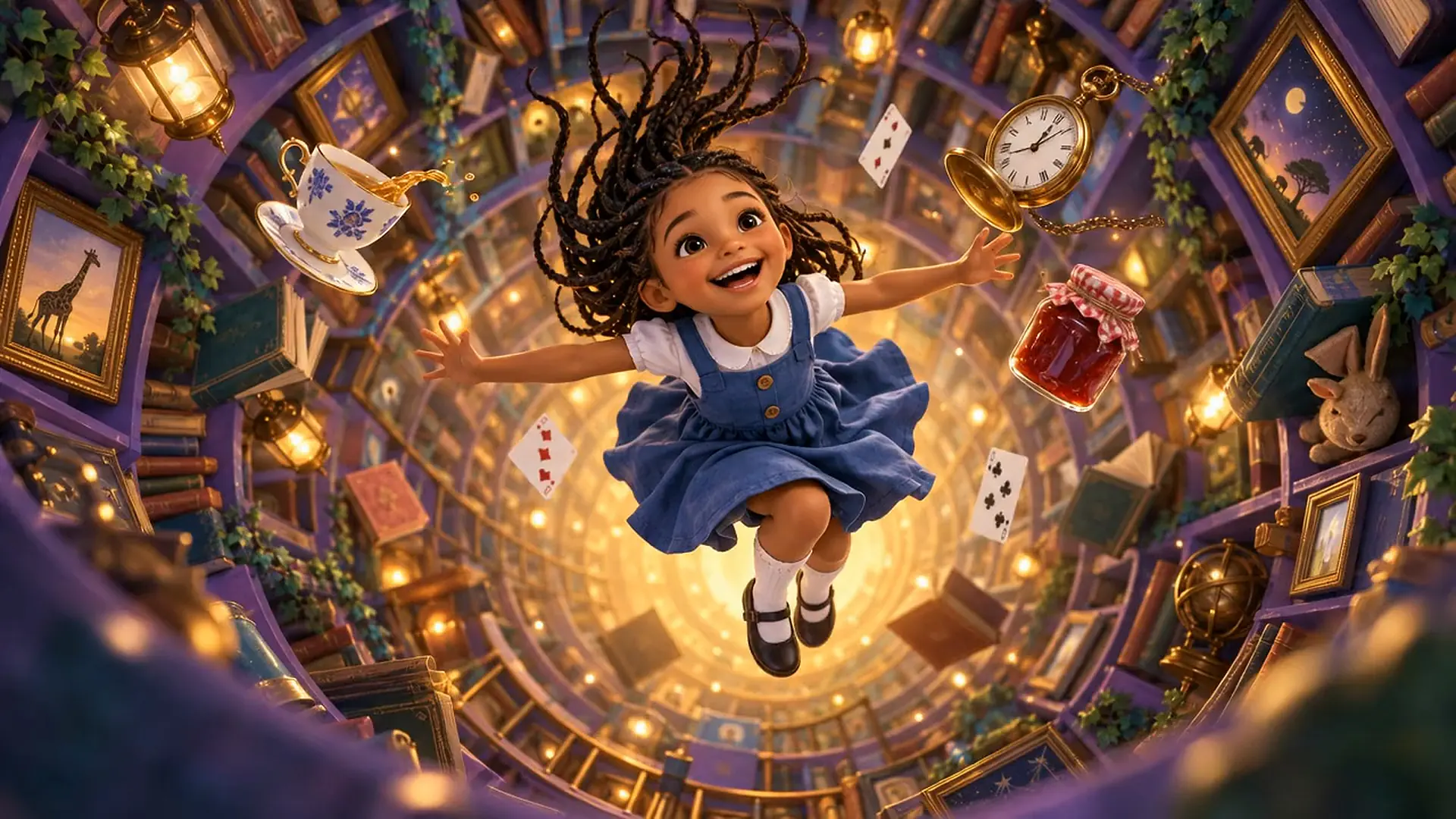
The first complaint in Alice’s Adventures in Wonderland comes before any rabbit appears, and it is about a book with no pictures.1 In Down the Rabbit Hole, our personalised Alice in Wonderland book, your child takes Alice’s place and follows Lewis Carroll’s White Rabbit to a hall where every door opens to the first sound of a name.
Alice was beginning to get very tired of sitting by her sister on the bank, and of having nothing to do: once or twice she had peeped into the book her sister was reading, but it had no pictures or conversations in it, ‘and what is the use of a book,’ thought Alice ‘without pictures or conversations?’
It is the best line a picture-book maker could ask for. The pictures are our job; the conversations are yours, and the parent’s page at the back of our book gives you things to try as you read. Why those conversations matter so much is the subject of reading aloud to children.
How did Alice in Wonderland begin?
As a story told aloud on a summer day. On 4 July 1862, Charles Dodgson, who wrote as Lewis Carroll, went on a boat trip up the Thames to Godstow with the Reverend Robinson Duckworth and three of the Liddell sisters, Lorina, Alice and Edith.2 That November his diary records: “Began writing the fairy-tale for Alice, which I told them July 4, going to Godstow - I hope to finish it by Xmas”. (He later said he wrote it out the same night; the British Library’s own record doubts it.)2
He finished the text by February 1863, and the pictures, 37 pen-and-ink drawings of his own, in September 1864. On 26 November 1864 he sent Alice Liddell the handwritten book, Alice’s Adventures Under Ground, inscribed “A Christmas Gift to a Dear Child in Memory of a Summer Day”.2 The first Alice book was a present made by hand for one named child.
The manuscript had adventures of its own. In 1928 it was sold at Sotheby’s for £15,400. In 1946 the Librarian of Congress, Luther Evans, had it bought at a sale for $50,000, and on 13 November 1948 he and a group of anonymous American subscribers presented it to the British Museum. It is now in the British Library.2
Why was the first printing of Alice recalled?
Because the illustrator hated it. Dodgson paid Oxford University Press £142 to print 2,000 copies in 1865, with pictures by John Tenniel, and Macmillan published it that July.3, 4 Tenniel, in the words of the OUP archive, “loathed the quality of Oxford’s printing”.3
Dodgson withdrew the edition and asked for the copies he had given away to be returned. He got about half of them back, and most of those were later given to children’s hospitals and orphanages.3 A new printing, by Richard Clay of Bungay, followed that November, and the remaining unbound 1865 sheets were sold to D. Appleton & Co. of New York in April 1866.4
So the first edition was not destroyed, as is sometimes said; it was scattered. About two dozen copies survive, which makes it rarer, one collector points out, than Shakespeare’s First Folio.5 It is a comfort to anyone who makes picture books: even Alice was reprinted because its pictures printed badly.
Why can we retell Alice in South Africa?
Because the book is long out of copyright here, on our reading of the Act (not legal advice). South Africa’s Copyright Act protects a book for the author’s life and fifty years from the end of the year in which the author dies.6 Carroll died in January 1898, so on that rule his words have been free to retell in South Africa since 1949, and Tenniel’s pictures since 1965. Later film designs have rights of their own, so we draw from the book and leave the screen versions alone.
Was Lewis Carroll a mathematician?
He was. Dodgson was a mathematical lecturer at Christ Church, Oxford, and Alice’s muddled times tables have kept readers busy ever since.3 In chapter two, testing her memory, she says “four times five is twelve, and four times six is thirteen”, and soon gives up: “I shall never get to twenty at that rate!”1
In 1952, in a book called The White Knight, A. L. Taylor pointed out that these sums come out right if the number base goes up by three each time. Four times five is twelve in base 18, four times six is thirteen in base 21, and so on, and the pattern never reaches twenty, which is exactly Alice’s complaint. Nobody knows whether Carroll meant it, and Taylor admitted there is no evidence that he did. Gardner, in his Annotated Alice, pointed to a plainer reason she never gets there: times tables then stopped at twelve, and on Taylor’s ladder four times twelve is nineteen.7
What happens in Down the Rabbit Hole?
Our Wonderland begins under a jacaranda tree in a Johannesburg back garden, on a sleepy afternoon. A White Rabbit in a waistcoat hurries past, staring at his pocket watch, and your child goes straight down the hole after him, floating past bookshelves, jars of jam and a ticking clock. In our sample the hero is Aisha, who is six, drawn like every hero from the photos a parent uploads.
At the bottom is a hall of doors, and none of them needs a key. “They open to sounds,” says the Rabbit, and he says the first sound of his own name: “Rrr… Rrr-Rabbit!” Click.
After that, every friend opens something with a first sound. The Mouse says “Mmm”, the Caterpillar “Kkk”, and the baby who turns into a pig “Ppp”. The Hatter and the March Hare find they share a sound. The three card gardeners need three: Five, Seven and Two. Then the Queen of Hearts points to a great golden gate that opens to one sound only, the first sound of your child’s name.
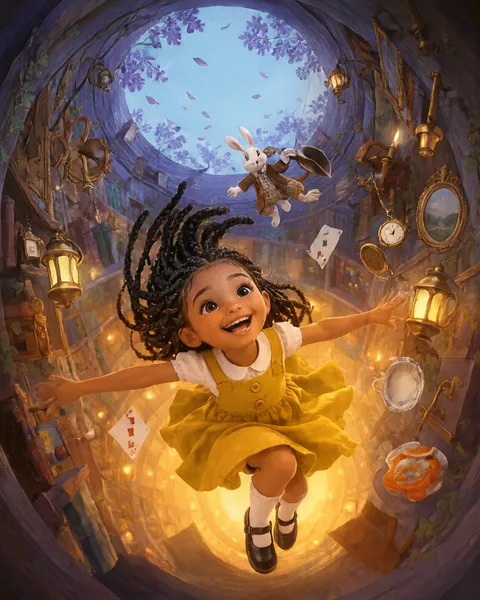
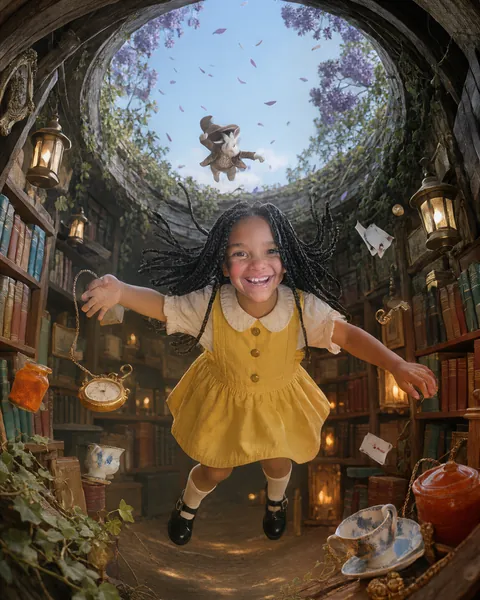
Your child says it, slow and clear, and the page asks the reader to say it too. The cards fly up and flutter down like jacaranda petals, and your child wakes in the garden, with a White Rabbit waving from the hedge.
The parent’s page at the back is careful about two things. Say the sound, not the letter: “mmm” for Mouse, not “em”. And some names begin with two letters that make one sound, like Th or Sh, and some with a click, as in many isiXhosa and isiZulu names, so use the first sound the way your family says the name. The Caterpillar and the Cheshire Cat make the same point from the other side: they share a first letter, but not a first sound.
Why the first sound of their own name?
Because it is one of the first things South Africa’s curriculum asks for. In the first term of Grade R, CAPS Home Language asks children to tell sounds apart, “especially at the beginning of own name”, and, as a first step towards seeing that words are made of sounds, to give “the beginning sound of own name”.8 The sound work is done by ear, in daily 15-minute sound games. Naming letters comes in the third term, with an example: “My name, Diane, begins with a letter d”.8
The research adds a twist. Children tend to know the first letter of their own name better than other letters, but in Treiman and Broderick’s studies the head start was for the letter’s name, not its sound.9 So a child’s name brings the excitement, and the sound still has to be practised, which is what our doors are for. The curriculum’s own example of the difference, four classmates’ names sorted two ways, is on our page about first sounds and phonics.
It is worth the practice. A large US review of early-literacy research, by the National Early Literacy Panel, found phonological awareness, the ability to hear and play with the sounds in spoken words, among six early skills with medium to large links to later reading, even after IQ and socioeconomic status were taken into account.10 Links like these can’t show cause on their own. Nobody knows yet how well our doors work, because the book is new; the sound play behind them has a long research record.
The curriculum wording here is from the Department of Basic Education’s CAPS English Home Language, Foundation Phase, Grades R to 3 (2011). CAPS is our reference; the Department of Basic Education doesn’t endorse us.
Drink me, and then what? Cause and effect in a story
Alice is also a book of causes. In our version a little bottle says DRINK ME; your child sips, and shrinks as small as a mouse. Later, crumbs from the Caterpillar’s mushroom bring them back to just the right size. One thing happens because of another, and the story only makes sense if you notice.
That is a named reading skill in Grade 1: CAPS asks children to recognise “cause and effect in a story”. The Grade R step before it is to predict “what will happen in a story through the pictures”.8 Children look for causes long before school, and our page on what children learn in Grade 1 has the curriculum’s example and the experiments that show it.
Who is Down the Rabbit Hole for?
It’s made for ages 3 to 7. Before Grade R, the sound games are play, and seeing their own name in the story is half the fun. In Grade R, the first sound of their name is part of the first term’s work. By Grade 1, the same story is a good one for talking about causes.
For the reading science in more depth, see first sounds and phonics; for the year around it, what children learn in Grade R and Grade 1 in South Africa.
Sources
- Carroll, L. (1865). Alice’s Adventures in Wonderland. London: Macmillan. Chapters I and II. Project Gutenberg eBook #11. gutenberg.org/ebooks/11
- British Library. Alice’s Adventures Under Ground, Add MS 46700 (catalogue record). searcharchives.bl.uk
- Oxford University Press Archives. Alice’s Day. archives.oup.com
- The Lewis Carroll Society. Publishing of Alice. lewiscarrollsociety.org.uk
- Fine Books Magazine (2016, 19 May). A new chapter for first edition of “Alice in Wonderland”. finebooksmagazine.com
- Copyright Act 98 of 1978 (South Africa), section 3(2)(a). acts.co.za. Our reading of the Act, not legal advice.
- Moktefi, A. (2020). Counting with Alice. Revista Internacional de Pesquisa em Educação Matemática, 10(2), 58–68, citing A. L. Taylor, The White Knight (1952), and Gardner’s Annotated Alice. doi.org/10.37001/ripem.v10i2.2173
- Department of Basic Education (2011). Curriculum and Assessment Policy Statement (CAPS): English Home Language, Foundation Phase, Grades R–3. Pretoria: DBE, pp. 26, 33–35, 46 and 69. education.gov.za (PDF)
- Treiman, R., & Broderick, V. (1998). What’s in a name: Children’s knowledge about the letters in their own names. Journal of Experimental Child Psychology, 70(2), 97–116. doi.org/10.1006/jecp.1998.2448
- National Early Literacy Panel (2008). Developing Early Literacy: Report of the National Early Literacy Panel. Washington, DC: National Institute for Literacy. nichd.nih.gov (PDF)