The Wonderful Wizard of Oz, 1900
The Golden Road: the real Oz, and the stars at the end of it
In Baum’s 1900 book the shoes are silver, and the Emerald City is green only through locked-on spectacles. This is what he wrote, why we can retell it, and how your child counts their way along the road.

In the first chapter of The Wonderful Wizard of Oz, before the cyclone arrives, L. Frank Baum uses the word “gray” (or “grayer”) ten times. The prairie is grey, and so are the house, the grass, Aunt Em, Uncle Henry and even the sky.1 Baum’s Oz is stranger and more particular than the film’s, and it is the one we retell in The Golden Road, our personalised Wizard of Oz book, where your child walks out of all that grey and counts their way to the stars.
What did Baum actually write?
Baum’s book was published in 1900 by George M. Hill of Chicago, with pictures by W. W. Denslow, and the Library of Congress calls it “America’s greatest and best-loved homegrown fairytale”.2 In a short introduction dated April 1900, Baum says what he was after: “a modernized fairy tale, in which the wonderment and joy are retained and the heartaches and nightmares are left out.”1
The grey does a job. Kansas is drained of colour so that Oz can arrive in a rush of it, and only one thing escapes: “It was Toto that made Dorothy laugh, and saved her from growing as gray as her other surroundings. Toto was not gray; he was a little black dog”.1 Our first page does the same: everything is painted in soft greys except your child and a small black dog. Two pages later the house lands with a bump, the door opens, and the grey is gone.
Baum kept going back. He wrote fourteen Oz books and styled himself “Royal Historian of Oz”, and when he died in May 1919 his publishers told his young readers, in the last of them, that “he went away to take his stories to the little child-souls who had lived here too long ago to read the Oz stories for themselves.”3, 4
Silver shoes or ruby slippers?
Silver. Baum describes them as “silver shoes with pointed toes”, and near the end Glinda tells Dorothy how they work: “All you have to do is to knock the heels together three times and command the shoes to carry you wherever you wish to go.”1 The ruby slippers were made for MGM’s 1939 film, which, the Smithsonian says, turned the book’s silver to red to show off the new Technicolor process.5
“There is no place like home” is Baum’s line, though not where the film puts it. Dorothy says it to the Scarecrow in chapter four, about grey Kansas. When she finally knocks her heels together, all she says is “Take me home to Aunt Em!”1
No matter how dreary and gray our homes are, we people of flesh and blood would rather live there than in any other country, be it ever so beautiful. There is no place like home.
The Emerald City is a trick, too. Everyone inside has green spectacles locked onto their head by the Guardian of the Gates, “and even on little Toto”. The Wizard owns up later: the city is no greener than any other, “but when you wear green spectacles, why of course everything you see looks green to you.”1 The film dropped the spectacles. We kept them: in The Golden Road a little green man hands them out at the gate, and everything turns green with a click.
Why can we retell it in South Africa?
Under South Africa’s Copyright Act of 1978, copyright in a book lasts for the author’s life and fifty years from the end of the year in which the author dies.7 On that rule, Baum’s words entered the public domain here on 1 January 1970, and Denslow’s pictures four years earlier (that’s our reading of the Act, not legal advice).
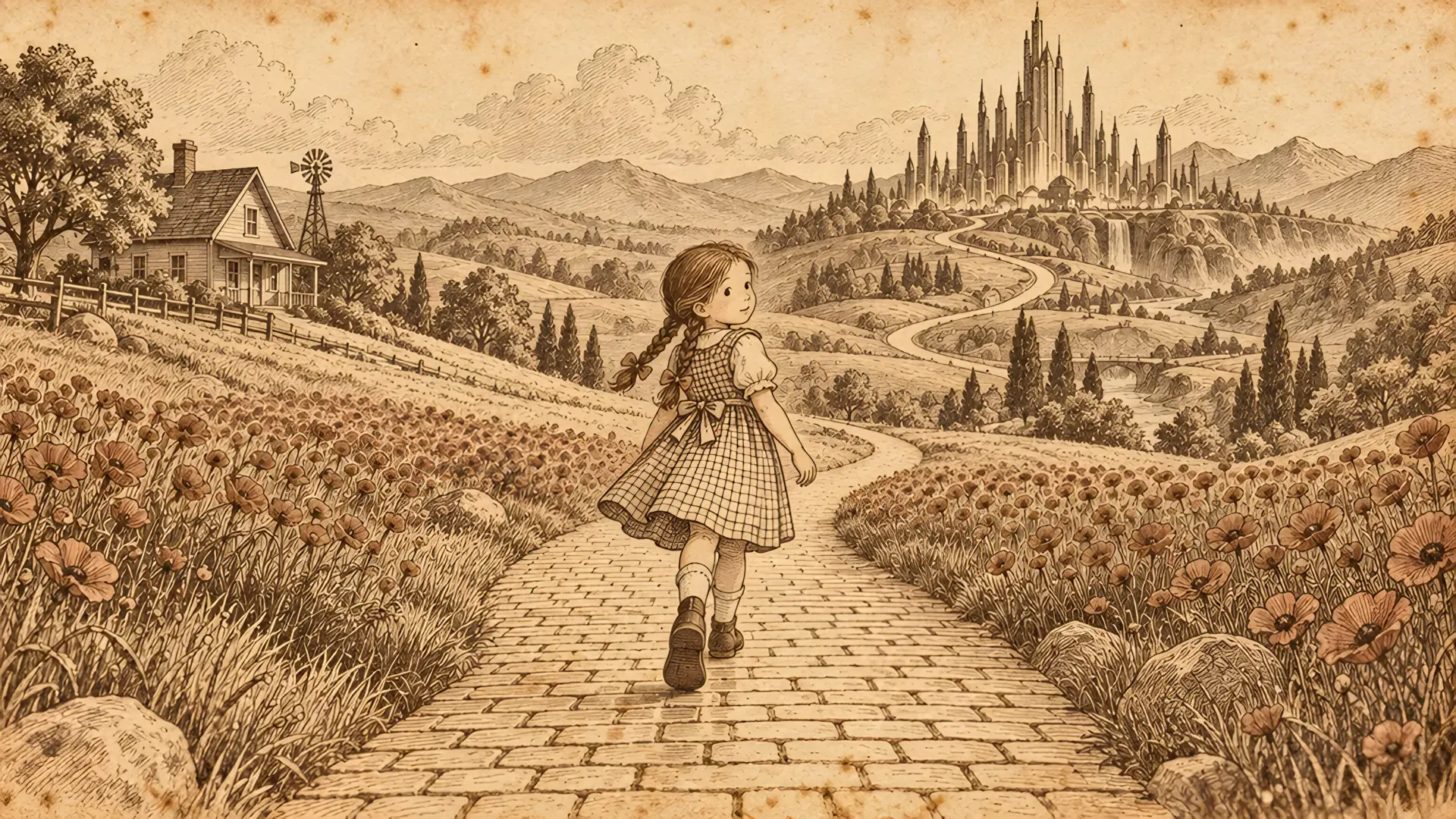
The 1939 film is another matter, and we steer clear of its look, the ruby slippers included. Our pictures follow Baum’s words, and the road is drawn our own way: honey-gold bricks through red poppies, towards slender green towers.
What happens in The Golden Road?
Your child is the hero, drawn from the photos you upload, in a bright yellow raincoat, with a small black dog called Toto at their heels. In our sample the hero is Lerato, who is six. On the grey prairie she says the line the whole book hangs on: “Count with me, and come with me!”
Then the wind comes, and the counting begins. The house spins three times. Four Munchkins come running, with bells on their hats. Five golden bricks start the road, the Scarecrow takes six wobbly steps (“I counted them all!”), and the Tin Woodman needs seven drops of oil. The Lion, counting his way through the dark wood, roars the eighth step himself. Nine logs make a raft, ten field mice pull the sleeping Lion out of the poppies, and the Emerald City has eleven green towers.
Behind a tall green screen, the great Wizard turns out to be a little old man with a kind, crinkly face, who tells the friends they found what they wanted on the road. “The Scarecrow had counted. The Tin Woodman had cared. The Lion had been brave. And Lerato had counted everyone in.” On the last page they lie on a hill under the night sky, and the book asks one question: how many stars can you count? There are twelve, one more than the towers, because the book’s skill is counting to 12.
What does it mean to really count?
Saying “one, two, three” in order is only half of counting. The other half is matching one number to each thing, and knowing that the last number you say tells you how many. South Africa’s curriculum asks Grade R children to “Estimate and count to at least 10 everyday objects reliably”,8 and the parent’s page at the back of The Golden Road suggests touching one shape for each number you say, then asking, “So how many?”
The check at the end asks the same question: when your child has counted the twelve stars, ask how many there are, and see whether they answer without counting again. What that answer does and doesn’t tell you, and the games that help, are in how children learn to count. The Golden Road itself is new and hasn’t been tested; what it asks of your child is ordinary, well-studied counting.
The curriculum wording here is from the Department of Basic Education’s CAPS Mathematics, Grade R (2011). CAPS is our reference; the Department of Basic Education doesn’t endorse us.
How do you find south with the Southern Cross?
The sample spread on our home page shows a smaller sky: seven stars to count, the five of the Southern Cross and the two bright Pointers beside it. They are worth knowing by heart, because together they find south without a compass.9 You can learn the trick on paper first, and take it outside on a clear night.
What do the stars of the Southern Cross mean?
According to the Astronomical Society of Southern Africa, in Sotho, Tswana and Venda traditions the stars of the Cross and the two Pointers are Dithutlwa, “the giraffes”, and the Venda called the fainter Cross stars Thudana, “the little giraffe”. Sotho lore says that when the giraffe stars sit close to the south-western horizon just after sunset, it is time to begin cultivating.10
The ǀxam saw the two Pointers as male lions, once men, turned into stars by a magical girl. To the Khoekhoe, the Pointers were Mura, “the eyes” of a great beast in the sky.10 Among the Venda, in lore the South African Astronomical Observatory shared with Royal Museums Greenwich, the giraffes were Thutlwa, “rising above the trees”: in October they skim above the trees on the evening horizon, reminding people to finish planting.11
The brighter Pointer, Alpha Centauri, is the nearest star system to the Sun. Its two bright stars are about 4.35 light years away, and their small companion, Proxima Centauri, is a little closer, at about 4.2.12
One of the first star distances ever measured was Alpha Centauri’s, from the Cape. Thomas Henderson, His Majesty’s Astronomer there, made the observations in 1832 and 1833, but his paper was laid before the Royal Astronomical Society in London only on 11 January 1839, two months after Friedrich Bessel’s result for another star was announced.13, 14 Bessel has the priority, and Henderson’s distance came out too small, but his observations came first.
Who is The Golden Road for?
It’s made for ages 3 to 7, and fits best from about four to six: the year before Grade R, when numbers start to mean something, and the Grade R year, when counting objects reliably to ten is the goal. A younger child can enjoy the grey turning to colour, and the refrain, long before they can count the towers. For how counting develops, with games that help, read how children learn to count; for the year itself, what children learn in Grade R; and for why we start with old tales at all, why fairy tales still matter.
Sources
- Baum, L. F. (1900). The Wonderful Wizard of Oz. Chicago: George M. Hill. Introduction and chapters I, II, IV, X, XV and XXIII. Project Gutenberg eBook #55. gutenberg.org/ebooks/55
- Library of Congress. The Wizard of Oz: An American Fairy Tale (exhibition). loc.gov/exhibits/oz
- Baum, L. F. (1920). Glinda of Oz. Chicago: Reilly & Lee. Title page and “To Our Readers”. Project Gutenberg eBook #39868. gutenberg.org/ebooks/39868
- International Wizard of Oz Club. Oz timeline, 1920–1938: Ruth Plumly Thompson, the second Royal Historian. ozclub.org
- Smithsonian National Museum of American History. Dorothy’s Ruby Slippers (fact sheet). americanhistory.si.edu
- Littlefield, H. M. (1964). The Wizard of Oz: Parable on Populism. American Quarterly, 16(1), 47–58. Baum’s aim is from his introduction (source 1).
- Copyright Act 98 of 1978 (South Africa), section 3(2)(a). acts.co.za. Our reading of the Act, not legal advice.
- Department of Basic Education (2011). Curriculum and Assessment Policy Statement (CAPS): Mathematics, Grade R. Pretoria: DBE, pp. 16, 19 and 41. education.gov.za (PDF)
- EarthSky (2026, 14 May). The Southern Cross: Your guide to due south. earthsky.org
- Astronomical Society of Southern Africa. African ethnoastronomy. assa.saao.ac.za
- Royal Museums Greenwich. South African star myths (extracts donated by the South African Astronomical Observatory). rmg.co.uk
- NASA Goddard Space Flight Center. The nearest star. Imagine the Universe! imagine.gsfc.nasa.gov
- MacTutor History of Mathematics, University of St Andrews. Parallax: Bessel and Henderson. mathshistory.st-andrews.ac.uk
- Warner, B. (2004). Thomas Henderson and α Centauri. In D. W. Kurtz (Ed.), Transits of Venus: New Views of the Solar System and Galaxy (Proceedings of IAU Colloquium 196). doi.org/10.1017/S1743921305001389