The tales
Older than any book
What scholars have learned about the age of fairy tales, which famous quotes about them don’t hold up, and what old stories still give a child.
One fairy tale, “The Smith and the Devil”, may have been told in the Bronze Age, in a language known today only by reconstruction.1 The argument over why fairy tales still matter for children is old too, and two of its most quoted lines can’t be traced to the men whose names they carry. South Africa has old tales of its own, from Jakkals in the Karoo to the San stories written down in a Cape Town house from 1870.
How old are fairy tales?
In 2016 an anthropologist at Durham University, Jamshid Tehrani, and a folklorist in Lisbon, Sara Graça da Silva, borrowed a tool from biology. Biologists rebuild the family trees of species by comparing the animals alive today. Da Silva and Tehrani did the same with 275 magic tales from 50 Indo-European-speaking populations, laid over the family tree of the languages those people speak.1
“The Smith and the Devil” came out with an 87% probability of having been told in Proto-Indo-European, the reconstructed ancestor of the whole language family, and the authors judged a Bronze Age origin plausible. Many other tales, they found, are far older than their first written versions.1 The numbers are probabilities, and they depend on which family tree of the languages you use; tales also pass between neighbours, which the method can’t fully see. Even so, here is a story that may have outlived the language it was first told in.
Jack is a humbler case, and a lesson in reading headlines. When the paper came out, the press reported that “Jack and the Beanstalk” was 5,000 years old. The paper says no such thing: it traced Jack’s family of tales a long way back, but not that far.1 What it did find is on our page about the history of Jack and the Beanstalk.
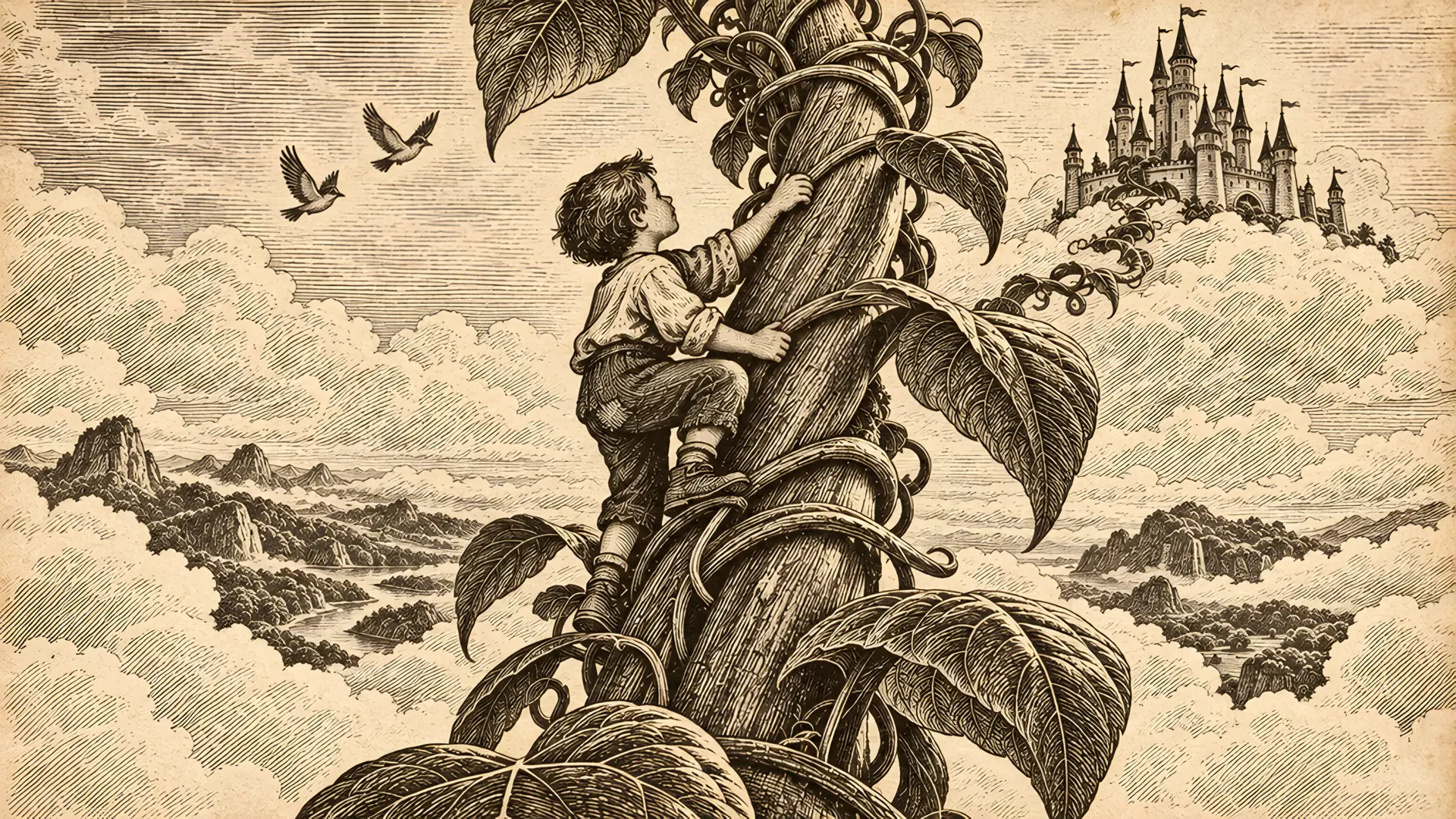
In print, by contrast, Jack is young: his oldest known printing, a joke in a Christmas miscellany, dates from 1734.2 The oldest printed version is not the oldest version. It is only the first one somebody bothered to set in type.
Three years before the Jack paper, Tehrani had built a family tree for “Little Red Riding Hood” and its cousin “The Wolf and the Kids”, where a wolf fakes a voice to be let in, from 58 versions told in 33 populations.3 The tree showed them to be two distinct tale types. Most of the African versions in his sample belong to the Wolf and the Kids; East Asian “Tiger Grandmother” tales look like a blend of both. Among his sources is an 1889 note in The Folk-Lore Journal with a title to make a South African reader sit up: “A South African Red Riding-Hood”.
You can hear the family resemblance in an 1886 collection of isiXhosa folktales. In the tale of Demane and Demazana, a cannibal burns his throat with a hot iron so that he can copy Demane’s voice and be let into the cave.4 Nobody has shown that the two tales share an ancestor, and we don’t claim it. But the trick is the wolf’s.
What did Chesterton really say about dragons?
The best-loved defence of fairy tales travels with G. K. Chesterton’s name on it: “Fairy tales are more than true: not because they tell us that dragons exist, but because they tell us that dragons can be beaten.” That sentence isn’t in the Chesterton essay it paraphrases. The tidy version is usually credited to the novelist Neil Gaiman, paraphrasing Chesterton at the front of Coraline in 2002.5
What Chesterton did write, in a 1909 essay called “The Red Angel”, is longer and stranger, and better.6 He was answering a reader who worried that fairy tales frighten children. “I find that there really are human beings who think fairy tales bad for children,” he writes, and then argues that the fear comes first:
Fairy tales do not give the child his first idea of bogey. What fairy tales give the child is his first clear idea of the possible defeat of bogey. The baby has known the dragon intimately ever since he had an imagination. What the fairy tale provides for him is a St. George to kill the dragon.
“If you keep bogies and goblins away from children they would make them up for themselves,” he writes. A good tale, in his account, takes a fear that has no edges and gives it some: it accustoms a child “to the idea that these limitless terrors had a limit”.
L. Frank Baum had wanted almost the opposite. His introduction to The Wonderful Wizard of Oz (1900) promised “a modernized fairy tale, in which the wonderment and joy are retained and the heartaches and nightmares are left out.”7 A bedtime story can sit somewhere between the two: a dragon worth worrying about, beaten before the light goes off. (For the everyday version of this, putting a worry into words, see our guide to helping children name their feelings.)
Did Einstein tell parents to read fairy tales?
The other famous line is about brains. Albert Einstein, the story goes, advised a mother that the way to raise an intelligent child was fairy tales, and then more fairy tales. We won’t print it in quotation marks, because there is no good evidence that he said it.
In 2013 Stephen Winick, a folklorist at the Library of Congress, went looking for the source.8 The earliest version he could find was in an article by Elizabeth Margulis, “Fairy Tales and More Fairy Tales”, in the New Mexico Library Bulletin of January 1958, retelling a second-hand anecdote about a mother asking Einstein what her son should read. From there the versions multiplied. Winick’s verdict is a folklorist’s joke, and a fair one: “Our analysis suggests that the story is itself folklore.”
He was careful to add that “Einstein may well have said this, or at least something similar to this.” We like that care. A story about why stories matter had become a story itself, passed from teller to teller and polished on the way.
The oldest printed version is not the oldest version. It is only the first one somebody bothered to set in type.
Are fairy tales really for children?
J. R. R. Tolkien thought the question was the wrong way round. In March 1939 he gave the Andrew Lang Lecture at the University of St Andrews, expanded in 1947 into the essay “On Fairy-Stories”.9 In it he argued that the link between children and fairy tales is an accident of history. Children, he thought, have no special taste for fairy stories and no special understanding of them; the modern literary world had sent the stories off to the nursery, and he thought that an error of false sentiment.10
He also insisted that children are meant to grow up, and he gave us two good words for what the stories do. “Eucatastrophe” is his name for the good catastrophe: the sudden, joyful turn of a good ending. “Recovery” is getting a clear view again of things we had long taken for granted.9
The other famous defence came from psychoanalysis. In The Uses of Enchantment (1976), Bruno Bettelheim argued, from Freud, that fairy tales help children work through their inner conflicts. In 1991 the folklorist Alan Dundes, in the Journal of American Folklore, accused Bettelheim of taking passages and key ideas, without acknowledgement, from Julius Heuscher’s 1963 A Psychiatric Study of Fairy Tales, and gave numerous examples.11 Whatever the borrowing, Bettelheim’s claims were interpretation, never tested, so we don’t cite him as proof of anything.
Chesterton’s essay survives the checking, though it was never a scientific claim; it was a wise one. The research that does exist is about reading aloud and the talk around it (see what the research says about reading aloud) and about stories that star the child (the science of starring).
South Africa’s own old tales
In 1864 the linguist Wilhelm Bleek published 42 fables, legends and tales, almost all of them Khoekhoe, and gave the book a dedication any parent would like: “This book belongs to children in South Africa and elsewhere”.12 Bleek did not collect the stories himself, and the storytellers’ names were not recorded. Thirteen of the tales are about Jackal.
Jackal, in these tales, is not a nice animal: he tricks Hyena again and again, and once promises to share with her before letting her fall from a cloud.12

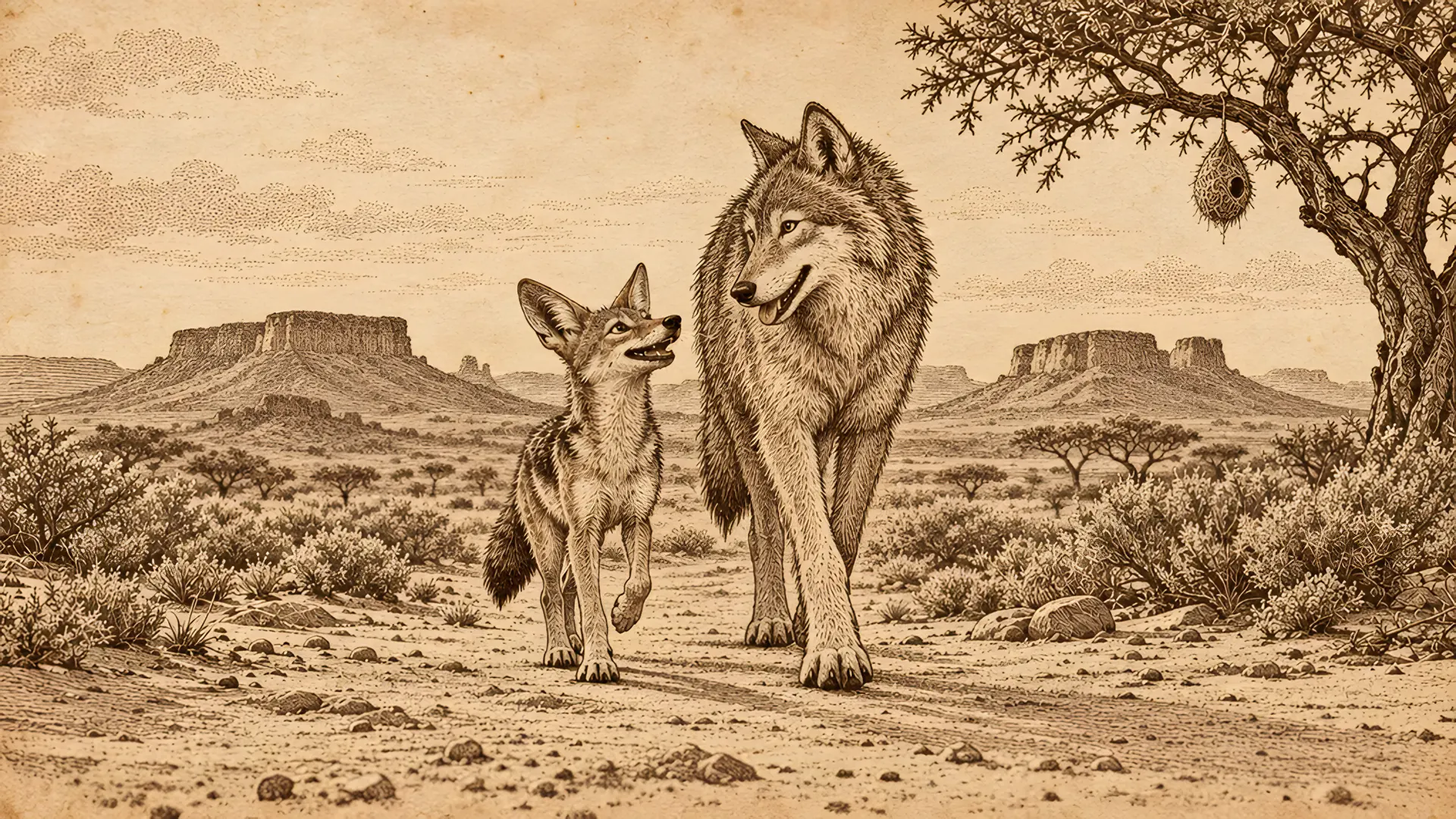
Tales like these came into Afrikaans as Jakkals en Wolf, from Khoi and San storytellers. Their Wolf was a hyena all along: old Afrikaans used “wolf” for hyena, as it used “tier” for leopard, and the early illustrations show a spotted one. The European wolf came in with a 1940s comic strip,13 and the picture at the top of this page, our own in the style of an old engraving, draws him that later way. The whole line, from Von Wielligh’s collections to the LPs of the 1980s, is on our Jakkals and Wolf page.
Why is South Africa’s motto in a language no one speaks?
Bleek’s greater work began in 1870. With his sister-in-law Lucy Lloyd, he recorded the language, stories and knowledge of ǀxam San teachers who lived with them in Mowbray, Cape Town (the upright strokes in ǀxam words are clicks, not the letter I).14 One of the first was ǁkabbo, a prisoner at the Breakwater.
The teachers came to the house through the colonial prison system, and that belongs in any honest telling. The result is some 14,000 pages.14 UNESCO inscribed the collection on its Memory of the World Register in 1997, and the script Bleek devised for the ǀxam clicks is still used by linguists.15
By 1910, when Dorothea Bleek visited descendants of those teachers, no one could remember the ǀxam stories or speak the language.14 Yet the language is on the country’s coat of arms: since Freedom Day, 27 April 2000, South Africa’s motto has been “ǃke e: ǀxarra ǁke”, in ǀxam, meaning “diverse people unite”.16 Its stories have outlived the language they were told in. They are still there to read because ǁkabbo and the other ǀxam teachers told them, and Bleek and Lloyd wrote them down.
What do old stories give children?
None of this proves that fairy tales make children cleverer. The quotation that says so can’t be traced to Einstein, and the grandest theory was never tested. What the history does show is what these stories are built to do, and that is plenty.
They are made to be retold. Joseph Jacobs, who collected English Fairy Tales in 1890, gave his source for Jack in a single line: “I tell this as it was told me in Australia, somewhere about the year 1860.”17 The 1886 isiXhosa collection noticed that its tales “are so constructed that parts of one can be made to fit into parts of another, so as to form a new tale”, like a child’s wooden blocks.4 An old tale is a set of parts that every teller may rearrange, which is an open invitation for a child to have a turn.
They give fear an edge. That was Chesterton’s point. Read the giant’s chant in a growl and watch a child grin: the fright is real, and so is the ending.
They trust children. When Benjamin Tabart’s 1807 edition gave Jack a fairy, to explain that the giant’s treasure was really his father’s,2 Jacobs took her out again, out of “greater confidence in my young friends”.17 Children can be trusted with a story that doesn’t explain itself.
They belong to the evening, and to the older people in a child’s life. The 1886 isiXhosa collection says who told them best, and when: “The best narrators are almost invariably ancient dames, and the time chosen for story telling is always the evening.”4 A 1908 collection of Swazi and Zulu tales describes children who “sit round the fire at night and hear them from their old grandmother”.18
That 1908 collection opens with a preface addressed “To all children who still love fairy tales”.18 It still covers most of the children we know, and a good many of their grandparents. (For giving a story across the generations, see our page on gifts from grandparents and godparents.)
Sources
- da Silva, S. G., & Tehrani, J. J. (2016). Comparative phylogenetic analyses uncover the ancient roots of Indo-European folktales. Royal Society Open Science, 3(1), 150645. doi.org/10.1098/rsos.150645
- The Hockliffe Project, De Montfort University. Park’s surprising history of Jack and the bean stalk (item 0033). hockliffe.dmu.ac.uk/items/0033.html
- Tehrani, J. J. (2013). The phylogeny of Little Red Riding Hood. PLoS ONE, 8(11), e78871. doi.org/10.1371/journal.pone.0078871
- Theal, G. M. (1886). [A collection of isiXhosa folktales; its title uses a slur, so we don’t print it.] Preface and “Demane and Demazana”. London: Swan Sonnenschein. Project Gutenberg eBook #71335. gutenberg.org/ebooks/71335
- Shmoop. “Fairy tales are more than true”: The epigraph of Neil Gaiman’s Coraline (2002). shmoop.com/quotes/fairy-tales-are-more-than-true.html
- Chesterton, G. K. (1909). The Red Angel. In Tremendous Trifles (essay XVII; first printed in the Daily News). London: Methuen. Project Gutenberg eBook #8092. gutenberg.org/ebooks/8092
- Baum, L. F. (1900). The Wonderful Wizard of Oz, Introduction. Chicago: George M. Hill. Project Gutenberg eBook #55. gutenberg.org/ebooks/55
- Winick, S. (18 December 2013). Einstein’s folklore. Folklife Today, Library of Congress. blogs.loc.gov/folklife/2013/12/einsteins-folklore
- The Tolkien Estate. On Fairy-stories. tolkienestate.com
- Popova, M. (5 December 2013). J.R.R. Tolkien on fairy-stories. The Marginalian (quoting Tales from the Perilous Realm). themarginalian.org
- Dundes, A. (1991). Bruno Bettelheim’s Uses of Enchantment and abuses of scholarship. Journal of American Folklore, 104(411), 74–83. doi.org/10.2307/541135
- Bleek, W. H. I. (1864). Reynard the Fox in South Africa (its subtitle uses a slur and is left out here). London: Trübner and Co. Dedication, preface, and fables 7 (Cloud-Eating) and 8 (Fish-Stealing). Project Gutenberg eBook #73413. gutenberg.org/ebooks/73413
- van Niekerk, J. (2018). Afrikaans stories of Jackal and Hyena: Oral and written traditions. Tydskrif vir Letterkunde, 55(3), 80–95. doi.org/10.17159/2309-9070/tvl.v.55i3.5511
- University of Cape Town News (4 April 2003). Jewel in UCT’s crown to be digitised for world’s scholars. news.uct.ac.za
- UNESCO Memory of the World. The Bleek Collection. unesco.org/en/memory-world/bleek-collection
- South African Government. National Coat of Arms. gov.za/node/127348
- Jacobs, J. (1890). English Fairy Tales, Notes and References, XIII (Jack and the Beanstalk). London: David Nutt. Project Gutenberg eBook #7439. gutenberg.org/ebooks/7439
- Bourhill, E. J., & Drake, J. B. (1908). Fairy Tales from South Africa, preface “To all children who still love fairy tales”. London: Macmillan. Project Gutenberg eBook #75833. gutenberg.org/ebooks/75833
- Postma, M. (1974). Tales from the Basotho (S. McDermid, trans.). Austin: University of Texas Press. Publisher’s description. ubcpress.ca/tales-from-the-basotho