Early reading
Before the letters, the sounds
Long before children read a word, they learn to hear the sounds inside words, and their own name is a natural place to start. What the research shows, what Grade R asks, and games to play tonight.
Hidden in South Africa’s Grade R curriculum is a small lesson in four names. Charmaine and Shireen belong together, because they start with the same sound, though not with the same letters. Mpho and Michael belong together because they start with the same letter.1 Sounds and letters are different things. Hearing the sounds in words comes first, before phonics matches them to letters, and a child’s own name is the natural place to start listening.
In short
- Reading starts with the ears: hearing the sounds inside spoken words, a skill called phonological awareness.
- In a large US review, it was one of six early skills that predicted later reading. Writing letters, or writing one’s own name, was another.
- Grade R begins with daily sound games, and in the first term asks children to give “the beginning sound of own name”. Letters come later.
- At home, play with the sound, not the letter’s name (“mmm”, not “em”), start with their name, and point to a word now and then as you read.
What is phonological awareness?
It is hearing, and playing with, the sounds inside spoken words: noticing that “cat” and “hat” rhyme, that “sun” and “sock” start the same way, that “dog” can be pulled apart into d, o, g. The US National Early Literacy Panel defined it as “the ability to detect, manipulate, or analyze the auditory aspects of spoken language”.2 It needs no letters and no books, so it can be practised in the bath or in the car.
The panel’s 2008 report is a large US federal review of early-literacy research. For the question of what predicts later reading, it drew on 299 research articles and found six early skills with “medium to large” links to later literacy, links that held even after IQ and socioeconomic status were taken into account. Phonological awareness was one. Another was “writing or writing name”: writing letters on request, or writing one’s own name.2
A predictor is not a cause, and most of the studies were of English speakers in the US. The best-known study to claim a cause is older. In 1983, in Nature, Bradley and Bryant reported a large project on the idea that young children’s skill at sorting words by rhyme and first sound helps them learn to read, under a title that made the claim plain: “Categorizing sounds and learning to read: A causal connection”.3
Why does a child’s own name come first?
Because it is one of the first sound patterns they recognise. Babies of about four and a half months already listen longer to their own name than to other names,4 and by six months they can use a very familiar word, such as their own name or “Mommy”, as a foothold to pick out the word that comes straight after it.5 Those studies, and what a child’s name does for learning, are in why children learn more from stories about themselves.
Names lead the way in print, too, and South Africa’s curricula reach for them first. The framework for children from birth to four notes that “Gradually children may recognise formal writing such as their own names.” In the first term of Grade R, children learn to recognise their own name “and names of at least five other children in the class”.6, 1
In a 1998 study of preschoolers and kindergartners in the US and first graders in Australia, Rebecca Treiman and Victor Broderick found that children in all three groups knew the name of the first letter of their own first name better than other letters; in a second study, US preschoolers could also print it better. The advantage was for the letter’s name, though, not its sound.7
So a boy called Sipho may proudly know “S” long before he links it with “sss”. That link is exactly what Grade R works on: the name brings the interest, and the sound still has to be taught.
What does Grade R ask?
Sounds first, letters later. The first term of Grade R has “Daily 15 minute activities” in phonological awareness. Children learn to tell sounds apart, “especially at the beginning of own name”, to say whether two sounds are the same or different, and to find the odd one out, as in the curriculum’s own example: “Which sound does not belong - b, b, k, b; d, d, d, t ?” Then comes the line this page is really about: “Begins to recognise that words are made up of sounds: gives the beginning sound of own name”.1
| When | In the curriculum’s words |
|---|---|
| Grade R, Term 1 | “gives the beginning sound of own name” |
| Grade R, Term 1 | “Identifies name in print”; “copies own name” |
| Grade R, Term 3 | “Recognises and names some letters of the alphabet especially own name” |
| Grade 1 | Phonics, “15 minutes per day for 5 days” (the suggested minimum) |
By the third term, when letters arrive, the examples are still names: “My name, Diane, begins with a letter d”. In Grade 1, phonics gets its own 15 minutes a day, in a Home Language week built on three strands: listening and speaking, reading and phonics, and writing and handwriting.1 The whole year is in what children learn in Grade R.
CAPS is our reference; the Department of Basic Education doesn’t endorse us. The quotations keep the DBE’s own wording and punctuation.
Is it the same in every South African language?
The Department publishes the Foundation Phase Home Language curriculum in all 11 official spoken languages,8 but the languages don’t ask the same of a young reader. Ten of the eleven have “transparent” spellings, where letters map regularly to sounds; as a 2021 report for the South African Human Rights Commission puts it, “only English does not”.9 In Grade 1, though, every language shares one benchmark, because they share one alphabet: 40 letter sounds a minute.10 That benchmark counts letter sounds, not letter names, which is the point of the next question.
How the languages part ways after that, and how to read with a child in two of them, is in raising a reader in more than one language.
Why say “mmm”, not “em”?
Because the sound is what reading uses. “Em” is the letter’s name; “mmm” is what it does at the start of “Mama”. When you play first-sound games, stretch the sounds that can stretch (mmm, sss, fff), keep the quick ones quick (k, p, t), and don’t worry about spelling yet. Charmaine and Shireen start with the same sound, whatever the letters say.
Say the sound the way your family says the name, too. Some names start with two letters that make one sound, like the Sh of Shireen, and the first sound is the one you hear, not the one you see.
Where does reading aloud fit in?
Reading aloud builds the language that reading needs; pointing out letters and words now and then builds the code. Pointing matters because, left to themselves, children barely look at the print. In a small eye-tracking study of ten preschoolers, only 2.7% of their fixations on a typical picture book landed on the words.11 They were looking at the pictures.
Stories build the language, and sound games build the code. Children need both.
A five-year study of 168 middle- and upper-middle-class children in Canada found two separate roads into reading. Being read to was linked with vocabulary and listening comprehension, which fed reading in Grade 3. Parents teaching about letters and words was linked with early literacy skills, which fed word reading at the end of Grade 1.12
Stories build the language, and sound games build the code. Children need both, and the two meet when you point: in a large US classroom trial, a little attention to print during read-alouds helped four-year-olds’ reading for two years after the programme ended.13
The trial used teachers in classrooms, but the home version costs nothing: “This word says Liam. It starts with lll.” There is much more on reading together in what the research says about reading aloud.
How does Down the Rabbit Hole use first sounds?
Our retelling of Alice’s Adventures in Wonderland turns the skill into the plot. At the bottom of the rabbit hole is a hall of doors, and every lock opens to a sound instead of a key. The White Rabbit opens the first by saying the first sound of his name. The Mouse, the Caterpillar, a pig and the Cheshire Cat open theirs, and at the tea party the Hatter and the Hare discover that they start with the very same sound. The great golden gate at the end opens to one sound only: the first sound of the child’s own name.
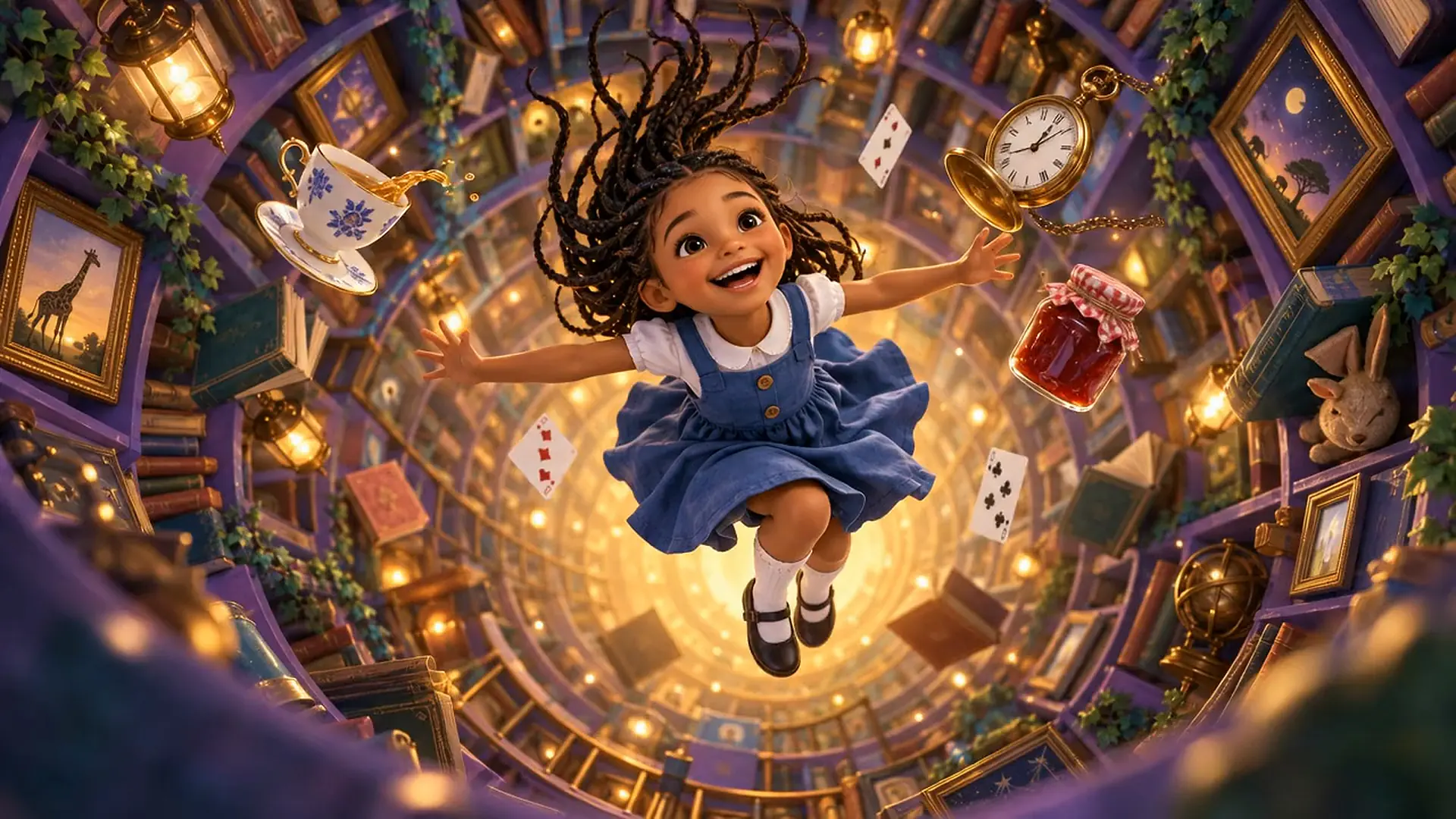
The parents’ page at the back suggests pausing at each lock on later reads, so your child can say the sound, and using the first sound the way your family says the name: many isiXhosa and isiZulu names start with a click, and then the click is the sound that opens the gate. Down the Rabbit Hole is new, and no study has looked at it; the step it practises is the Grade R one described above, built around your child’s own name. The story behind it is on the Down the Rabbit Hole page.
Sound games to play tonight
A few minutes is plenty, and the best time to stop is while it’s still funny.
Children hear sounds at their own pace. If you’re ever worried about your child’s hearing or speech, ask the teacher, a clinic sister or your doctor.
Sources
- Department of Basic Education (2011). Curriculum and Assessment Policy Statement (CAPS): English Home Language, Foundation Phase, Grades R–3. Pretoria: DBE. Time allocation (pp. 8–9), Grade R Term 1 (pp. 33–35), Grade R Term 3 (p. 46). education.gov.za (PDF)
- National Early Literacy Panel (2008). Developing Early Literacy: Report of the National Early Literacy Panel. Washington, DC: National Institute for Literacy. pp. vii, 56. nichd.nih.gov (PDF)
- Bradley, L., & Bryant, P. E. (1983). Categorizing sounds and learning to read: A causal connection. Nature, 301, 419–421. doi.org/10.1038/301419a0
- Mandel, D. R., Jusczyk, P. W., & Pisoni, D. B. (1995). Infants’ recognition of the sound patterns of their own names. Psychological Science, 6(5), 314–317. doi.org/10.1111/j.1467-9280.1995.tb00517.x
- Bortfeld, H., Morgan, J. L., Golinkoff, R. M., & Rathbun, K. (2005). Mommy and me: Familiar names help launch babies into speech-stream segmentation. Psychological Science, 16(4), 298–304. doi.org/10.1111/j.0956-7976.2005.01531.x
- Department of Basic Education (2015). The South African National Curriculum Framework for Children from Birth to Four. Pretoria: DBE. Communication (p. 40). education.gov.za (PDF)
- Treiman, R., & Broderick, V. (1998). What’s in a name: Children’s knowledge about the letters in their own names. Journal of Experimental Child Psychology, 70(2), 97–116. doi.org/10.1006/jecp.1998.2448
- Department of Basic Education. Curriculum and Assessment Policy Statements (CAPS): Foundation Phase, Grades R to 3, in each official language. education.gov.za
- South African Human Rights Commission (2021). The Right to Read and Write (Section 11 Committee), p. 7. ru.ac.za (PDF)
- Department of Basic Education (2025). Funda Uphumelele National Survey: Summary Report. Pretoria: DBE. Section 1.2 and Table 1. education.gov.za (PDF)
- Justice, L. M., Skibbe, L., Canning, A., & Lankford, C. (2005). Pre-schoolers, print and storybooks: An observational study using eye movement analysis. Journal of Research in Reading, 28(3), 229–243. doi.org/10.1111/j.1467-9817.2005.00267.x
- Sénéchal, M., & LeFevre, J.-A. (2002). Parental involvement in the development of children’s reading skill: A five-year longitudinal study. Child Development, 73(2), 445–460. doi.org/10.1111/1467-8624.00417
- Piasta, S. B., Justice, L. M., McGinty, A. S., & Kaderavek, J. N. (2012). Increasing young children’s contact with print during shared reading: Longitudinal effects on literacy achievement. Child Development, 83(3), 810–820. doi.org/10.1111/j.1467-8624.2012.01754.x