Grandparents and godparents
From Gogo, with love
Nearly half of South Africa’s children share a home with a grandparent. What the research says about good gifts, what we call our grandparents, and how to give a book with the child as the hero.

In 2023, about 9.7 million South African children, nearly half of them, lived in the same home as a grandparent.1 So Gogo or Oupa is part of everyday life for many of them, and a gift for a grandchild is about more than the day it is opened. A godparent’s gift for a godchild can be too.
In short
- Givers tend to shy away from sentimental gifts, though in experiments the people receiving them would often have preferred them.
- South Africa has many words for grandparents, and some are built on a root that means “great”.
- Telling a grandchild a story may do some of what reading does, and in one US study toddlers learned from a live video call in ways they didn’t from a recording.
- With our books, the child’s parent uploads the photos and says yes. We can send the book to the family with no prices in the parcel.
How many children in South Africa live with grandparents?
The figures come from a 2025 Statistics South Africa report, based on its 2023 household survey. Those 9.7 million children, out of about 21 million, lived with about 6.7 million grandparents, and 69.3% of the grandparents were grandmothers.1
About 8 million children, 38% of all children, lived in a household headed by a grandparent, up from 32% in 2002. Nearly one household in seven held three generations, and in the countryside about one in thirteen was a “skip-generation” home: grandparents and grandchildren, with no parent in between.1
“Living with” is not the same as “raised by”. In grandparent-headed homes, 56% of children had their mother living with them too, and about a third lived with neither parent.1 Of the children who lived apart from both parents in 2022, 80% had a living mother. As the University of Cape Town’s Children’s Institute puts it, “Parental absence does not necessarily mean parental abandonment.”3 In millions of homes, a grandparent may be the one reading at bedtime.
What makes a good gift from a grandparent?
Grandparents have had a bad press from economists. In a famous 1993 study of Christmas presents, Yale students valued non-cash gifts from grandparents lowest of all, but they had been told to leave out sentimental value, the very thing a grandparent’s gift is best at.4 The full story is in the psychology of a good gift.
Put it back, and the picture changes. In three US studies, adults choosing a gift for a friend or partner often passed over a sentimental one, such as a framed photo of the two of them together, for one matched to the other person’s tastes, though the people receiving would have preferred the sentimental gift.5
The simplest improvement is to ask. Across five studies, people appreciated gifts they had asked for more than ones they hadn’t, while givers assumed both would land equally well.6 A four-year-old doesn’t write a wish list, so ask Mum or Dad what the little one can’t stop talking about. Dinosaurs, ballet or rugby can become their own adventure.
What do South African children call their grandparents?
Gogo has travelled so far into South African English that it’s easy to forget it is isiZulu. Each language has its own words, and in Unisa’s courses for new speakers of isiZulu, isiXhosa, Sesotho and Sepedi they are also how you greet anyone of your grandparents’ age.7
| Language | Grandmother | Grandfather |
|---|---|---|
| isiZulu | gogo | mkhulu |
| isiXhosa | makhulu | tat’omkhulu |
| Sesotho | nkgono | ntatemoholo |
| Sepedi | koko | rakgolo |
| Setswana | nkuku | rremogolo |
| Afrikaans | ouma | oupa |
Some of these words carry a compliment. Makhulu is built on the Nguni root ‑khulu, “great, big”, and mkhulu is a term of respect meaning “one of rank”, “old one” or “great one”.8 Nelson Mandela was often called Khulu, which, the Nelson Mandela Foundation explains, “means great, paramount, grand”: it is “a shortened form of the isiXhosa word ‘Tat’omkhulu’ for ‘grandfather’”.9
The Afrikaans words are plainer: Dutch oud, “old”, plus ma and pa. The Dictionary of South African English finds ouma in English writing by 1841, spelt “oud mamma”, and oupa by 1915. Isie Smuts, wife of the Prime Minister Jan Smuts, was known to the whole country as Ouma Smuts.8 In Setswana a grandmother may also be mmemogolo and a grandfather ntatemogolo. And as one linguist records, mmemogolo can mean your mother’s elder sister too, while Sepedi has its own words for great-grandparents, rakgolokhukhu and mmakgolokhukhu.10
Why read with your grandchild?
Thirteen grandmothers were among the carers when researchers tested book sharing with babies in Khayelitsha. In that randomised trial, published in 2015, carers who joined eight weekly sessions on sharing picture books, taught in isiXhosa by two women from the community, reported afterwards that their babies understood and said more words than the other group’s babies did.11 These were the carers’ own reports, straight after the course, but it is a lovely result from close to home. There’s more in reading aloud: what the research says.
Learning runs both ways. Researchers who spent time with nine families in East London, some Bengali-speaking and some English-speaking, found grandparents guiding three- to six-year-olds, and children teaching back: six-year-old Sahil showed his grandmother Razia how to play Solitaire on the computer. They noted that “touch is a particularly significant mode of communication” between the generations.12 Not all of it needs you in the room. In one small US study, toddlers learned from a live video chat partner in ways they didn’t from a recording of the same person.13
Reading may even be good for the reader. In a small Japanese trial, 58 older adults were randomly assigned to 12 weeks of training to read picture books to children, or to health lectures, and the readers improved in delayed verbal memory.14 A later trial in middle-aged adults found no memory gain: a hopeful hint, then.
Stories told aloud may count too. Picture books hold more rare words than everyday talk, but one researcher who compared them, D. W. Massaro, argues that the difference is mostly formal versus informal language, not print versus speech.15 So, we’d say, a grandparent telling an old story in rich, careful isiZulu or Afrikaans is doing some of the same work.
How do I give one of your books if I’m not the parent?
Start with the parent. Only a parent, legal guardian or someone else who may legally consent for the child can upload their photos, so we ask them for the photos and their go-ahead before we make anything. There’s nothing to pay until you’ve seen the cover, and we can send the finished book straight to the family with no prices in the parcel. What happens to the photos afterwards is in our questions and answers.
Every format includes the animated trailer, and the digital edition is the ebook and trailer on their own, easy to share with family in another city. Books come in English, isiZulu, isiXhosa, Afrikaans and Sesotho, so a book from Makhulu can be in isiXhosa; there’s more on that in raising readers in a multilingual home.
Buying for several grandchildren? In six experiments, people shopping for several recipients tried so hard to make each gift different that they passed up ones that would have been better liked, even when nobody would compare.16 A book that stars the child gets round that: one idea, and a story of their own for each.
What makes a good gift from a godparent?
Godparents came before gossip. The English “gossip” began as Old English godsibb, a godparent, literally a “god-relative”: Archbishop Wulfstan used it in about 1015. By about 1275 a gossip was a close friend, and only from the 16th century was it someone who indulges in idle talk.17
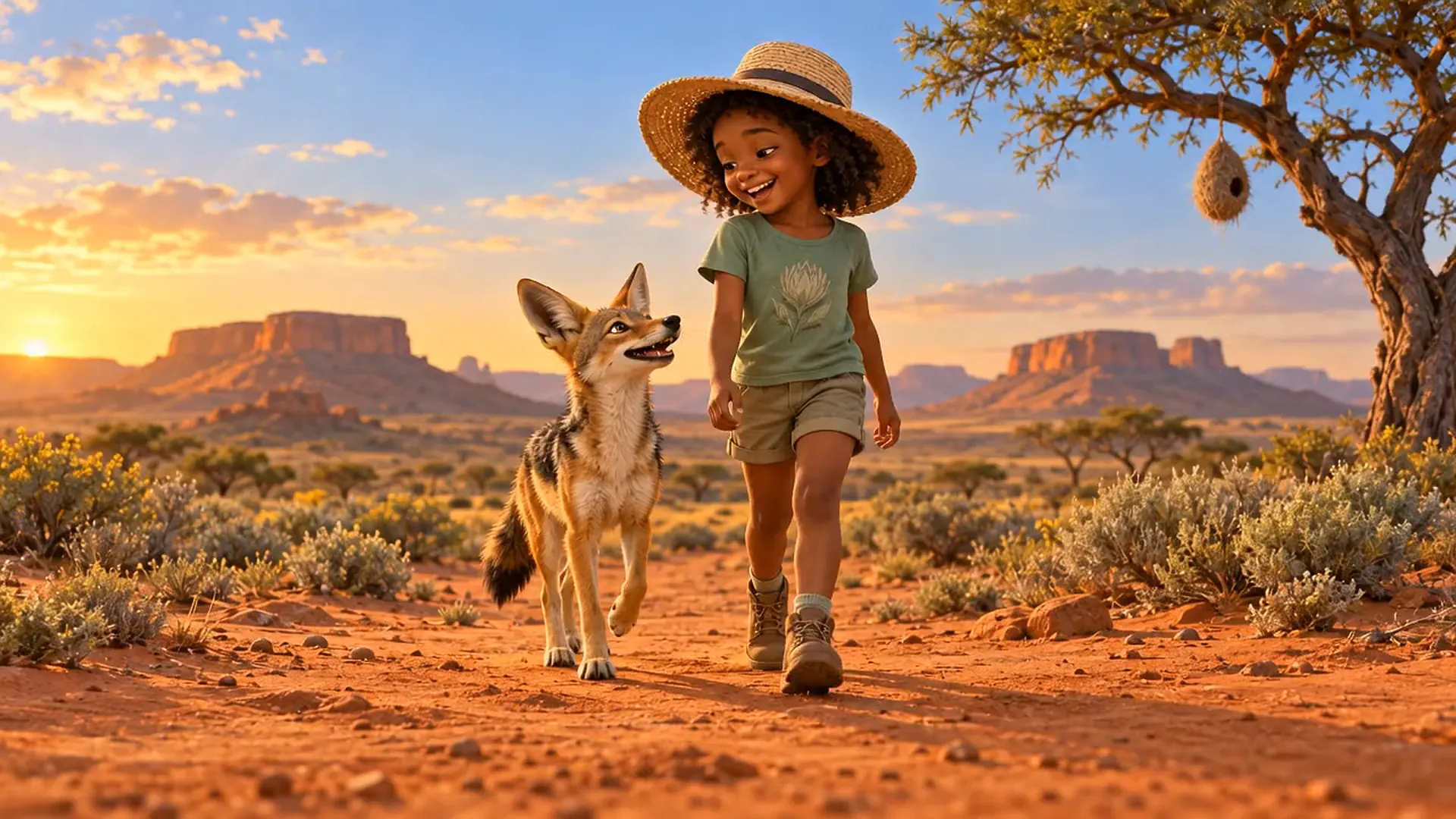
Give something that shows you were paying attention. A book with your godchild as the hero is close to what Givi and Galak called a sentimental gift, the kind their givers found risky and their adult recipients preferred, though the studies didn’t test books.5 And it is good for you too: in the last of Zhang and Epley’s experiments, thinking hard about a gift made the giver feel closer to the person receiving it.18 Each of our five stories opens with a dedication to the child. In Jakkals and Wolf, a South African folk tale about taking turns, it reads: “For Thandi, who knows that the best things are even better shared.”
Sources
- Statistics South Africa (2025). Child Series Volume IV: Children living with grandparents in South Africa, 2023 (Report 92-02-04). Pretoria: Stats SA. Foreword, Tables 1.1, 2.2 and 4.2, and Figures 1.1 and 1.2. statssa.gov.za (PDF)
- Duflo, E. (2003). Grandmothers and granddaughters: Old-age pensions and intrahousehold allocation in South Africa. The World Bank Economic Review, 17(1), 1–25. doi.org/10.1093/wber/lhg013
- Hall, K. (2025). Demography: Children living with parents. Children Count, Children’s Institute, University of Cape Town. childrencount.uct.ac.za
- Waldfogel, J. (1993). The deadweight loss of Christmas. American Economic Review, 83(5), 1328–1336 (Table 3). jstor.org/stable/2117564
- Givi, J., & Galak, J. (2017). Sentimental value and gift giving: Givers’ fears of getting it wrong prevents them from getting it right. Journal of Consumer Psychology, 27(4), 473–479. doi.org/10.1016/j.jcps.2017.06.002; Carnegie Mellon University release, 25 July 2017. eurekalert.org
- Gino, F., & Flynn, F. J. (2011). Give them what they want: The benefits of explicitness in gift exchange. Journal of Experimental Social Psychology, 47(5), 915–922. doi.org/10.1016/j.jesp.2011.03.015
- University of South Africa. Learn to speak an African language, Theme 1: isiZulu, isiXhosa, Sesotho and Sepedi (PDFs). Setswana from Molalapata (2004) and Afrikaans from the Dictionary of South African English, both below.
- Dictionary of South African English on Historical Principles, Rhodes University: “ouma”, “oupa”, “makhulu” and “Mkhulu”. dsae.co.za/entry/ouma, dsae.co.za/entry/oupa, dsae.co.za/entry/makhulu, dsae.co.za/entry/mkhulu
- Nelson Mandela Foundation (2007). One man, many names. nelsonmandela.org
- Molalapata, B. T. (2004). The treatment of kinship terminology in Sotho dictionaries, with special reference to Setswana. MA dissertation, University of Pretoria. hdl.handle.net/2263/22894
- Vally, Z., Murray, L., Tomlinson, M., & Cooper, P. J. (2015). The impact of dialogic book-sharing training on infant language and attention: A randomized controlled trial in a deprived South African community. Journal of Child Psychology and Psychiatry, 56(8), 865–873. doi.org/10.1111/jcpp.12352
- Kenner, C., Ruby, M., Jessel, J., Gregory, E., & Arju, T. (2007). Intergenerational learning between children and grandparents in East London. Journal of Early Childhood Research, 5(3), 219–243. doi.org/10.1177/1476718X07080471
- Myers, L. J., LeWitt, R. B., Gallo, R. E., & Maselli, N. M. (2017). Baby FaceTime: Can toddlers learn from online video chat? Developmental Science, 20(4), e12430. doi.org/10.1111/desc.12430
- Suzuki, H., Kuraoka, M., Yasunaga, M., Nonaka, K., Sakurai, R., Takeuchi, R., Murayama, Y., Ohba, H., & Fujiwara, Y. (2014). Cognitive intervention through a training program for picture book reading in community-dwelling older adults: A randomized controlled trial. BMC Geriatrics, 14, 122. pmc.ncbi.nlm.nih.gov/articles/PMC4247720; the follow-up in middle-aged adults: Iizuka, A., et al. (2021). Randomized controlled trial of the picture book reading program on cognitive function in middle-aged people. Frontiers in Psychiatry, 12, 624487. doi.org/10.3389/fpsyt.2021.624487
- Massaro, D. W. (2015). Two different communication genres and implications for vocabulary development and learning to read. Journal of Literacy Research, 47(4), 505–527. doi.org/10.1177/1086296X15627528
- Steffel, M., & LeBoeuf, R. A. (2014). Overindividuation in gift giving: Shopping for multiple recipients leads givers to choose unique but less preferred gifts. Journal of Consumer Research, 40(6), 1167–1180. doi.org/10.1086/674199
- Wilton, D. Gossip. Wordorigins.org (citing the Dictionary of Old English, the Middle English Dictionary and the Oxford English Dictionary). wordorigins.org
- Zhang, Y., & Epley, N. (2012). Exaggerated, mispredicted, and misplaced: When “it’s the thought that counts” in gift exchanges. Journal of Experimental Psychology: General, 141(4), 667–681. doi.org/10.1037/a0029223