An English folk tale
Up the Beanstalk: an old giant, a new friend, and the pairs that make ten
The tale has been printed, tidied up and argued over for nearly three centuries. In our retelling the giant is lonely, nothing is stolen, and every step of the climb makes ten.

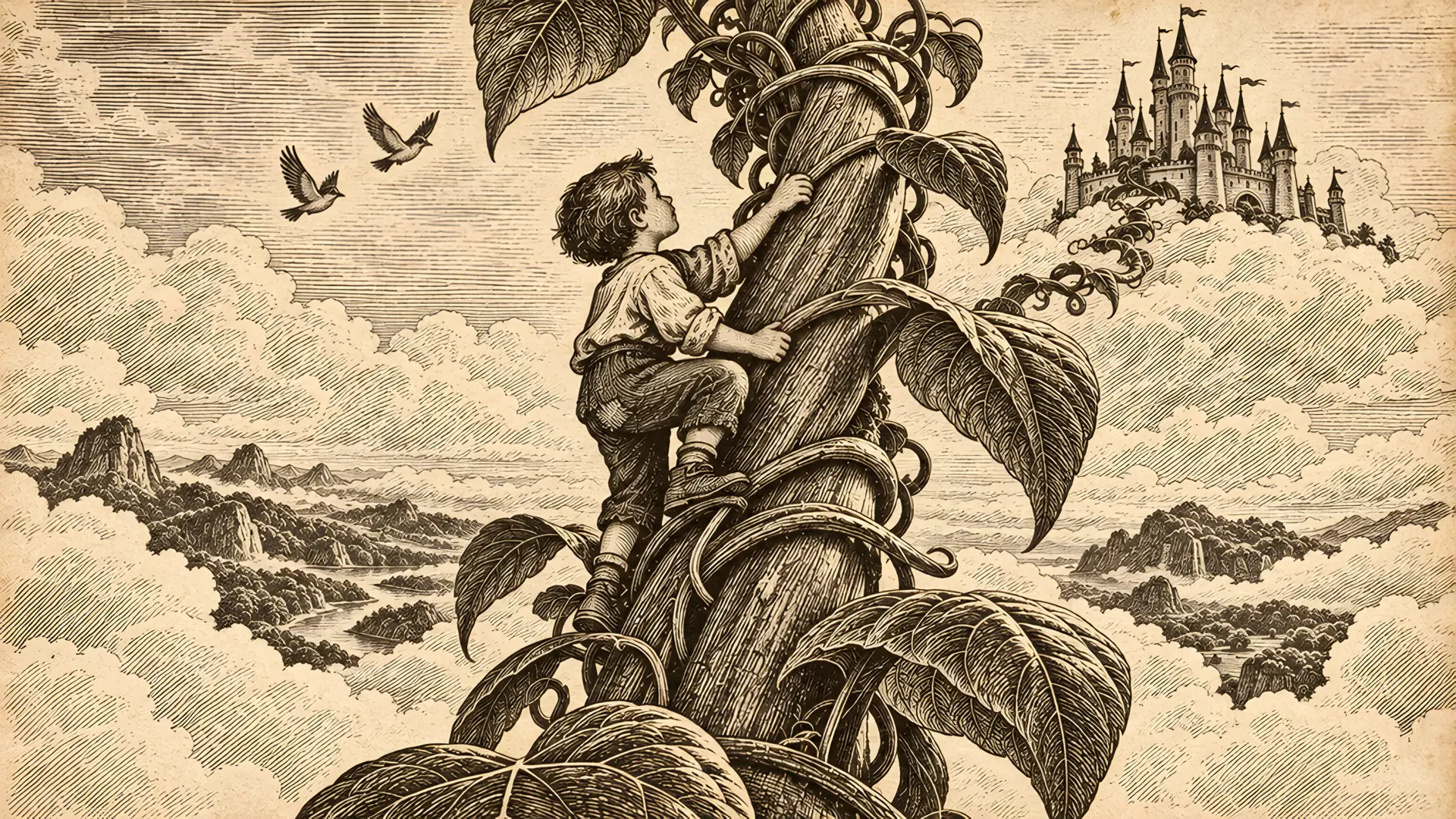
The oldest known printed version of Jack and the Beanstalk is a joke. It appeared in a 1734 edition of a Christmas miscellany, Round About Our Coal-Fire, as a burlesque called “Enchantment demonstrated in the story of Jack Spriggins and the Enchanted Bean”, which pokes fun at beanstalks and cities in the sky but already has much of the story we know.1 Ours is one of the newest. In Up the Beanstalk, a personalised Jack and the Beanstalk, your child climbs to a lonely giant’s castle and practises number bonds to 10 on the way.
Where does Jack and the Beanstalk come from?
The earliest known edition of the tale as we now tell it is a book published in 1807 by Benjamin Tabart.1 The scholars at the Hockliffe Project suggest its editor was Mary Jane Godwin, or possibly William Godwin, the father of Mary Shelley. Whoever it was had a problem: Jack is a thief. So the book gives him a fairy, who explains that all the giant’s treasure once belonged to Jack’s father, whom the giant had killed. Jack isn’t stealing, only taking back.
In 1890 the folklorist Joseph Jacobs, collecting his English Fairy Tales, took the fairy out again. He told the story, he wrote, “as it was told me in Australia, somewhere about the year 1860”, and he had no patience for the improvement.2
The object of this was to prevent the tale becoming an encouragement to theft! I have had greater confidence in my young friends, and have deleted the fairy who did not exist in the tale as told to me.
Up the Beanstalk starts from Jacobs’s telling and adds a third answer to the old question. Our giant hasn’t had a visitor “for years and years”. Nothing is taken: your child plays with him, finishes his harp’s song, and climbs down with one golden egg that he gives them to keep.
Is Jack and the Beanstalk really 5,000 years old?
Probably not, though you may have read that it is. In 2016 Jamshid Tehrani, an anthropologist at Durham, and Sara Graça da Silva, a folklorist in Lisbon, borrowed family-tree methods from evolutionary biology and used them on 275 magic tales told in 50 Indo-European-speaking populations.3 They concluded that many tales probably began long before their first written versions, and found evidence that one, “The Smith and the Devil”, can be traced back to the Bronze Age.
Jack’s family of tales, which folklorists file as ATU 328, “The Boy Steals the Ogre’s Treasure”, came out differently. The analysis placed it securely in the shared ancestor of the Italic and Celtic branches of the language family (and of those two with Germanic), but put the chance that it goes back to the much older Proto-Indo-European at only 39%, which on the study’s own measure leans slightly against it.3 The 5,000 years came from the newspapers, not from the paper.
The careful version is still remarkable: some scholars think the family of stories Jack belongs to is thousands of years old, older than any book. For how scholars trace old tales, and why they still matter to children, read why fairy tales still matter.
Where does Fee-fi-fo-fum come from?
It is older than any printed Jack. The chant has been in English for at least four hundred years: in King Lear, Edgar, pretending to be mad, sings a scrap of a ballad about Childe Rowland, “Fie, foh, and fum, / I smell the blood of a British man.”4 Jacobs, whose telling has the familiar rhyme (“Fee-fi-fo-fum, / I smell the blood of an Englishman”), noted that the formula “is common to all English stories of giants and ogres”.2
He also spotted a clue in Shakespeare’s word “British”. James I was declared King of Great Britain in October 1604, and Jacobs took the word as one of the points that date the play.2 Scholars now place King Lear at about 1605 or 1606, which fits, though the date rests on more than one word.
In Up the Beanstalk the giant still booms “Fee-fi-fo-fum!” as he thuds into his kitchen, then asks, “Who’s that in my kitchen?” Your child waves and says hello. It is a good line to boom together.
What happens in Up the Beanstalk?
Your child is the hero, drawn from the photos you upload. In our sample it’s Sipho, who is seven, in a red hoodie. He takes Milky-White, the family’s gentle old cow, to market, and on the way a funny little old man offers him beans: two in one hand and eight in the other. “Two and eight make ten,” says Sipho, and from then on every stage of the climb is a pair that makes ten.
Seven leaves grow on one side of the stalk and three on the other. Six bluebirds fly past on one side and four on the other. Five cloud stones lead to the castle, then five more.
Inside, the giant’s hen has laid eight golden eggs in the basket and two in the straw, and his harp always stops one note short of its song until the child plucks the last string. Then the two of them play Make Ten with their fingers, all the way to ten fingers up and none down. Between the pairs runs a refrain for your child to finish: “Make it ten, climb again!” By the last page they have met every pair, even ten and none.
What are number bonds, and when do children learn them?
A number bond is a pair of numbers that make another, known well enough to come without counting: seven and three make ten, so ten take away seven leaves three. South Africa’s curriculum, CAPS, has no number bonds in Grade R. In Grade 1 children practise bonds to 5 in the first term, then to 7, then to 9, and finally “Practise number bonds to 10” in the fourth term. Grade 2 starts the year with bonds to 10 again, then moves on through 15 to 20, and Grade 3 goes to 30.5, 6 These are facts children are expected to “know or recall fairly quickly”.6
Ten matters because our numbers are built in tens: once seven-and-three comes instantly, a child can make a ten instead of counting in ones, and sums like 17 and 3 get much easier.
Why English hides the ten inside “eleven” and “twelve”, and what the research says about learning these pairs, is in our parent’s guide to number bonds.
The curriculum wording here is from the Department of Basic Education’s CAPS Mathematics documents for Grade R and Grades 1 to 3 (2011). CAPS is our reference; the Department of Basic Education doesn’t endorse us.
How does the book show each ten?
As two groups to look at, so that a child can see the whole and its two parts at once: seven leaves and three, eight eggs and two. The parent’s page at the back suggests counting both groups, asking “So how many make ten?”, and on later reads covering one group with your hand and asking how many are hiding. CAPS describes the same idea, with children who “partition and combine quantities” and “build up and break down numbers”.6 No one has put the book itself to the test yet, because it is new; the part-and-whole thinking it practises is well studied.
Who is Up the Beanstalk for?
It’s made for ages 3 to 7 and is a Grade 1 book at heart, best from about six, when bonds to 10 are the year’s work. A confident five-year-old can meet it early, as a preview of Grade 1 rather than as Grade R work, and because Grade 2 opens with bonds to 10 again, it still fits at seven. The giant, the golden egg and the chant work at any of those ages.
For the maths in more depth, read number bonds to 10 and 20: a parent’s guide, and for the year around it, Grade 1 in South Africa and Grade 2. For a younger child, The Golden Road starts one step earlier, with counting.
Sources
- The Hockliffe Project, De Montfort University. Park’s surprising history of Jack and the bean stalk (item 0033). hockliffe.dmu.ac.uk
- Jacobs, J. (1890). English Fairy Tales. London: David Nutt. “Jack and the Beanstalk”, and Notes and References. Project Gutenberg eBook #7439. gutenberg.org/ebooks/7439
- da Silva, S. G., & Tehrani, J. J. (2016). Comparative phylogenetic analyses uncover the ancient roots of Indo-European folktales. Royal Society Open Science, 3(1), 150645. doi.org/10.1098/rsos.150645
- Shakespeare, W. King Lear, Act III, Scene IV. Project Gutenberg eBook #1532. gutenberg.org/ebooks/1532
- Department of Basic Education (2011). Curriculum and Assessment Policy Statement (CAPS): Mathematics, Foundation Phase, Grades 1–3. Pretoria: DBE, pp. 43 and 59. education.gov.za (PDF)
- Department of Basic Education (2011). Curriculum and Assessment Policy Statement (CAPS): Mathematics, Grade R. Pretoria: DBE, pp. 9, 11, 13 and 23. education.gov.za (PDF)