Early maths
The pairs that make ten: a parent’s guide to number bonds
Before children add quickly, they learn to see a number as parts: ten is seven and three. Why that matters, what Grades 1 and 2 ask, and games to play at home.
In 1992 the psychologist Karen Wynn reported in Nature that five-month-old babies looked longer when 1 + 1 or 2 − 1 seemed to come out wrong, and concluded that “humans are innately endowed with arithmetical abilities”.1 Eight years later, a repeat of the experiment with 68 babies found “no systematic evidence of either imprecise or precise adding and subtracting in young infants”.2 Whatever babies can do (the debate is still lively), the quick, sure adding that school asks for is learned, and much of it rests on number bonds: the pairs that make 10, and later 20, known so well that nobody needs to count.
In short
- A number bond is a pair of numbers that make another: seven and three make ten, so ten take away seven leaves three. The aim is to know the pairs well enough that they come without counting.
- CAPS has no number bonds in Grade R. Grade 1 climbs from bonds to 5 up to bonds to 10, Grade 2 goes on to 20, and Grade 3 to 30.
- Ten matters because our numbers are built in tens. A child who knows the pairs can “make a ten” instead of counting in ones.
- Seeing the parts helps: dice, dominoes, fingers and a ten-frame.
What is a number bond?
Ten is seven and three, or six and four, or nine and one. Each of those pairs is a number bond, and the goal is to know them so well that they come without counting. A child who really knows that seven and three make ten gets three more facts for free: three and seven make ten, ten take away seven leaves three, and ten take away three leaves seven. Maths teachers call this part-whole thinking: the whole is ten, and the parts can swap places or change size while the whole stays the same.
South Africa’s curriculum describes the same idea in its own words: children build their sense of number as they “partition and combine quantities” and “build up and break down numbers”.3 Breaking ten into seven and three, and putting it back together, is exactly that.
Can you see a number bond?
You can. Knowing that three dots on a dice are three, without counting, is called subitising (the word’s story is in our guide to how children learn to count). The kind that matters here is what the maths educator Douglas Clements calls conceptual subitising: seeing the six on a domino as three and three, a whole made of parts, taken in at a glance.4
Fingers are a ready-made version. Seven fingers held up is a whole hand and two more, and the three still folded down are the three that would make ten. After a quick look at a dice, a domino or a flash of fingers, ask “How did you see it?” A child who says “three and two” is doing part-whole thinking with their eyes.
Why is ten so important?
Because our numbers are built in tens. A child who knows that eight needs two more to make ten can do 8 + 5 without counting: take two from the five to make ten, and three are left over, so it’s 13. The same move turns 17 + 3 into 20, and 13 take away 5 into two short hops: back three to ten, then two more to 8. Without the pairs, each of these is a long count in ones, with plenty of room to slip.
English makes the tens harder to hear than some languages do: “eleven” and “twelve” hide the ten that Chinese number names for 11 to 19 say out loud, and in a 1995 study that difference showed up in young children’s counting.5 We haven’t seen a study like it for South Africa’s languages, so we make no claim about them. The study, and the teens that Grade 2 works on, are in Grade 2 CAPS.
What is a ten-frame?
A ten-frame is two rows of five boxes, with a counter in some of them. It shows any number up to ten as part of ten. Seven is a full row of five and two more, and the three empty boxes are the three that would make ten. Nine has a single gap that almost asks to be filled.
You can draw one on the back of a cereal box in a minute, and dried beans, bottle tops or buttons make good counters. One honest note: we found no good evidence on how well the ten-frame works on its own. Still, it earns its place as a clear picture of the pairs.
What do Grades 1 and 2 ask?
CAPS has no number bonds in Grade R, where the nearest thing is to “Solve verbally stated addition and subtraction problems with solutions up to 10”.3 Bonds arrive in Grade 1 and climb one step a term.6
- Grade 1: bonds to 5 in the first term, then to 7, then to 9, and to 10 in the fourth term.
- Grade 2: bonds to 10 again in the first term, then to 15, then to 20 for the rest of the year.
- Grade 3: bonds to 30.
In the curriculum’s own words, the year’s targets are “Practise number bonds to 10” for Grade 1 and “Practice number bonds to 20” for Grade 2.3, 6 These are facts the curriculum expects children to “know or recall fairly quickly”: in practice, without having to count.3
So a five-year-old who enjoys the pairs is meeting Grade 1 work early, which is fine as long as it stays a game. For the years themselves, read Grade 1 in South Africa and Grade 2 CAPS.
CAPS even starts fractions with fair shares instead of symbols: in the Foundation Phase “learners are not expected to read or write fraction symbols”, and one Grade R problem asks children to share cookies between teddies “so that they all get the same number of cookies”.3 For the psychology of fairness, read sharing and taking turns.
The curriculum wording here is from the Department of Basic Education’s CAPS Mathematics documents for Grade R and Grades 1 to 3 (2011), quoted with their own spelling. CAPS is our reference; the Department of Basic Education doesn’t endorse us.
Does early maths really matter?
In 2007 Greg Duncan and his colleagues pooled six long-term studies of children in the United States, the United Kingdom and Canada. Maths skills at school entry predicted later school achievement more strongly than early reading did, and reading more strongly than attention.7 That doesn’t prove that teaching maths early causes later success, but the link is a striking one.
In a randomised trial in 36 US preschool classrooms, Douglas Clements and Julie Sarama found that children’s maths scores rose far more over 26 weeks in classrooms using a research-based programme called Building Blocks than in classrooms with no special maths programme, and more than in classrooms using a different maths curriculum.8 Measured as effect sizes, the first gap (1.07) was more than twice the second (0.47). That was a full programme taught by trained teachers, a long way from a bedtime book, but it shows that early maths can be taught.
At home, little and often may be the way. Asking a child to remember beats telling them again, at least for new names in a small UK study of preschoolers,9 and the habit suits number bonds well: a quick “seven and how many make ten?” while you wait at a robot, and again tomorrow.
How does Up the Beanstalk practise them?
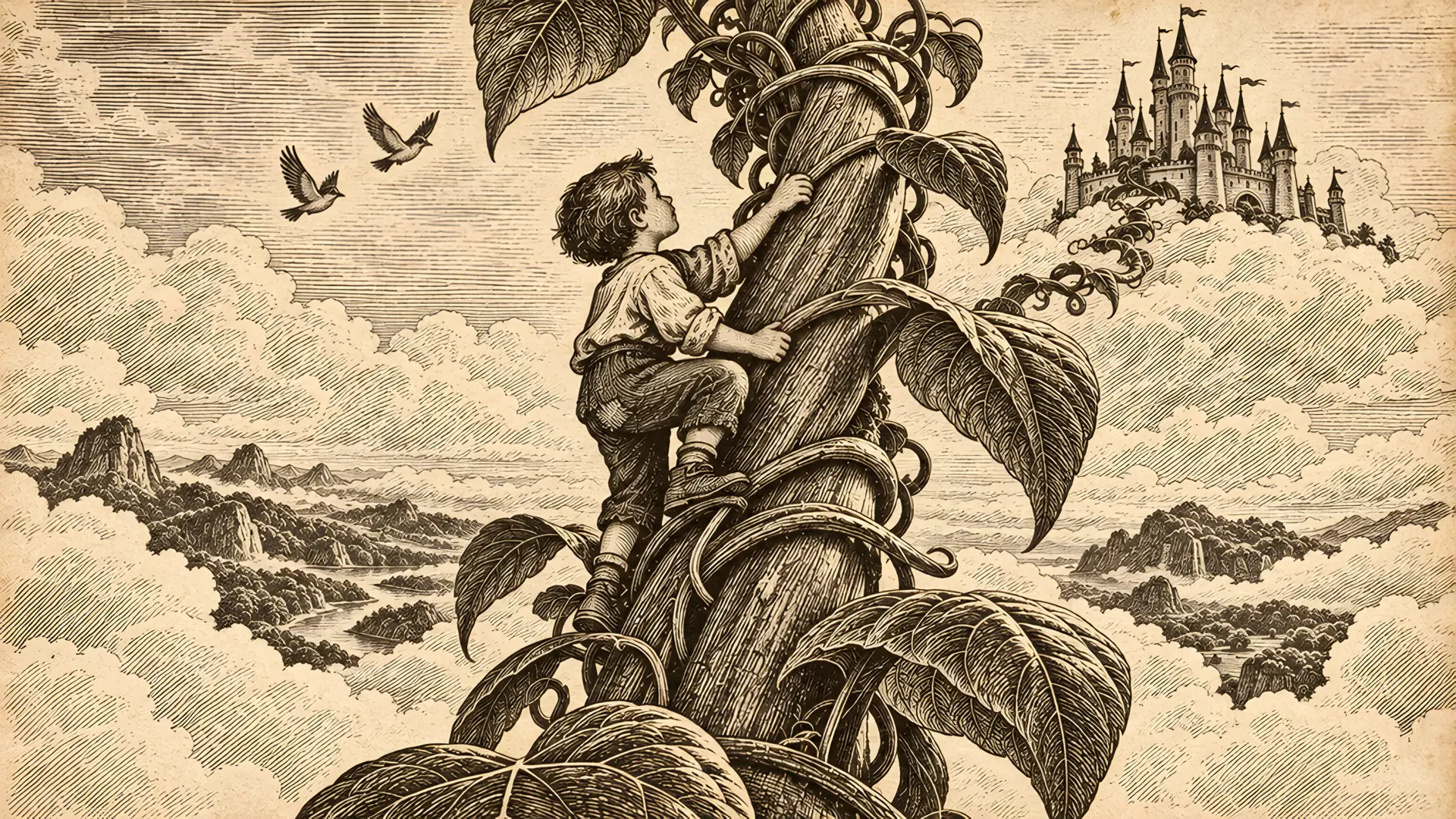
Our number-bonds book, Up the Beanstalk, turns the story into a string of pairs that make ten, from the road to market to the top of the clouds: two magic beans and eight, seven leaves and three, six bluebirds and four, five cloud stones and five more. In the giant’s kitchen there are eight golden eggs in the basket and two in the straw, and a harp that sings nine notes and stops, one short, until your child plucks the last string. Then child and giant play Make Ten with their fingers, all the way to ten fingers up and none down.

The harp is the idea we like best, because its problem is a maths problem: nine notes, and one missing. In a US study of 49 children aged three to six watching clips from educational cartoons, children were best at using a clip’s solution themselves when the fantasy in it was moderate, or when the fantastical part came at a moment that was relevant to solving the problem.10 That study used video, and our book is still unstudied. Even so, the same idea runs through its pages: the beanstalk is make-believe, and the beans really add up.
The parent’s page at the back suggests counting both groups on each page, asking “So how many make ten?”, and on later reads covering one group with your hand to ask how many are hiding. The check is quick: hold up seven fingers and see whether your child can tell you that three more make ten, without counting from one. As written, the book practises the pairs that make ten; for twenty, the games below take over.
Games for number bonds at home
Children meet the pairs at different speeds, and Grade 1 spends a whole year building up to bonds to 10. If counting itself still feels shaky, start a step earlier with how children learn to count. And if you’re worried, your child’s teacher is the best person to ask.
Sources
- Wynn, K. (1992). Addition and subtraction by human infants. Nature, 358, 749–750. doi.org/10.1038/358749a0
- Wakeley, A., Rivera, S., & Langer, J. (2000). Can young infants add and subtract? Child Development, 71(6), 1525–1534. pubmed.ncbi.nlm.nih.gov/11194253
- Department of Basic Education (2011). Curriculum and Assessment Policy Statement (CAPS): Mathematics, Grade R. Pretoria: DBE, pp. 9, 11, 13, 23 and 48. education.gov.za (PDF)
- Clements, D. H. (1999). Subitizing: What is it? Why teach it? Teaching Children Mathematics, 5(7), 400–405. doi.org/10.5951/tcm.5.7.0400
- Miller, K. F., Smith, C. M., Zhu, J., & Zhang, H. (1995). Preschool origins of cross-national differences in mathematical competence: The role of number-naming systems. Psychological Science, 6(1), 56–60. doi.org/10.1111/j.1467-9280.1995.tb00305.x
- Department of Basic Education (2011). Curriculum and Assessment Policy Statement (CAPS): Mathematics, Foundation Phase, Grades 1–3. Pretoria: DBE, pp. 43 and 59. education.gov.za (PDF)
- Duncan, G. J., Dowsett, C. J., Claessens, A., Magnuson, K., Huston, A. C., Klebanov, P., … Japel, C. (2007). School readiness and later achievement. Developmental Psychology, 43(6), 1428–1446. doi.org/10.1037/0012-1649.43.6.1428
- Clements, D. H., & Sarama, J. (2008). Experimental evaluation of the effects of a research-based preschool mathematics curriculum. American Educational Research Journal, 45(2), 443–494. doi.org/10.3102/0002831207312908
- Fritz, C. O., Morris, P. E., Nolan, D., & Singleton, J. (2007). Expanding retrieval practice: An effective aid to preschool children’s learning. Quarterly Journal of Experimental Psychology, 60(7), 991–1004. doi.org/10.1080/17470210600823595
- Richert, R. A., & Schlesinger, M. A. (2017). The role of fantasy–reality distinctions in preschoolers’ learning from educational video. Infant and Child Development, 26(4), e2009. doi.org/10.1002/icd.2009