Early maths
The last word counts: how children learn to count
A child who can chant to ten may still not be able to hand you five spoons. Here’s what happens in between, what Grade R asks, and five games that help.
In 1990 the psychologist Karen Wynn asked two- and three-year-olds in the United States to hand her a certain number of things. The younger children could manage one, and sometimes two, and never used counting to get there, even at an age when many children can recite the numbers.1 Between reciting numbers and knowing them is a gap, and how children learn to count is mostly the story of crossing it. The games that help need nothing fancier than the walk to bed or a bowl of peas.
In short
- Reciting numbers and counting are different skills. Children typically work out that the last number tells you “how many” at around three and a half, though they vary a lot.
- A classic account splits counting into five principles, best read as a map: one number for each thing, the same order every time, the last number is the total, anything can be counted, and you can start anywhere.
- Grade R asks children to “Estimate and count to at least 10 everyday objects reliably”, starting with 1 to 5 in the first term.
- Count real things in front of you, often, and go past three. Then ask “So how many?” and, now and then, “Can you give me five?”
Why can my child count to ten but not give me five?
Because the words come first and the meaning follows. Wynn’s 1990 study, with groups of 24 and 18 children aged two and three, found that children learn what the smaller number words mean before the larger ones: “one”, then “two”, then up to three or four. Only after that, at roughly three and a half, do they grasp the rule behind all the rest: the last number you say when you count tells you how many there are. Asked “how many?” straight after counting, only the older children in her study, the ones around that age, gave the last number they had said most of the time.1
Even the right answer can fool you. Barbara Sarnecka and Susan Carey put it plainly in 2008: “Many children answer the question ‘how many’ with the last word used in counting, despite not understanding how counting works”.2 So ask the question the other way round as well: “Can you give me five?” is harder to bluff. A child who counts out five pegs and stops has it.
What are the five counting principles?
In 1978 two psychologists, Rochel Gelman and Randy Gallistel, published The Child’s Understanding of Number, which described counting as five principles.3 Each is a separate thing a child has to get right, and each can be practised in a game.
- One-to-one. One number word for each thing, no more and no less. This is the one that slips when a finger runs ahead of the mouth.
- Stable order. The words always come in the same order: one, two, three, never one, three, two.
- Cardinality. The last word you say tells you how many.
- Abstraction. Anything can be counted: spoons, jumps, claps, even sounds you can’t see.
- Order doesn’t matter. Start with any object, left to right or right to left, and the answer is the same.
Treat the list as a map rather than a verdict on what toddlers know. In 1983 Gelman and a colleague summed up their view in a paper’s title: “Preschoolers’ counting: Principles before skill”.4 The studies by Wynn, and by Sarnecka and Carey, suggest that one principle at least, cardinality, is learned slowly.1, 2 The argument is still alive, but either way the map tells you which part of counting has slipped when it does.
Can children see a number without counting?
Yes, for small amounts. Glance at three dots on a dice and you know it’s three before you could possibly count them. Psychologists call this subitising, a word coined in 1949 from the Latin for “sudden”.5 The maths educator Douglas Clements distinguishes two kinds: perceptual subitising is simply seeing three, and conceptual subitising is seeing the six on a domino as three and three.6
The first kind is a shortcut around counting. The second is the start of something bigger, seeing a number as made of smaller numbers, which is where number bonds to 10 and 20 begin. Dice games, dominoes and fingers flashed up and taken down quickly all practise it.
Does counting at home make a difference?
The research links everyday number talk at home with what children later know. In a US study of 44 children, Susan Levine and her colleagues measured how much parents talked about numbers when their children were between 14 and 30 months old. The children who heard more number talk knew more about what number words mean at 46 months, nearly four, even after the family’s socioeconomic status and other kinds of talk were taken into account.7
A follow-up asked which kinds of number talk went with that later understanding. Counting or naming sets of things the child could see did, and other number talk didn’t. Sets of four to ten were more strongly linked than small ones.8 These are correlations from small US studies, so on their own they prove little, but the advice they point to costs nothing: count real things, often, and go past three.
Games help too, if they are the right games. In 2008 Robert Siegler and Geetha Ramani gave preschoolers from low-income US families a board with a straight row of ten numbered squares, like Snakes and Ladders with no snakes and no ladders, and the children said the numbers aloud as they moved. Four 15-minute sessions “eliminated the differences” in number-line estimation between them and better-off children.9
In a second study of low-income US preschoolers averaging 5.4 years, about an hour of the game improved four different number skills: comparing numbers, placing them on a number line, counting, and reading numerals. The gains were still there nine weeks later.10
Stories can carry maths as well. In a randomised study of 47 children in US Head Start preschools, eight weeks of shared reading built around maths words such as “more”, “fewer”, “between” and “behind” improved the children’s general maths knowledge as well as their maths vocabulary, compared with a group who carried on as usual.11 Trained staff did the reading, with plenty of questions and talk; our piece on reading aloud has more on reading that way.
Why does early number matter in South Africa?
Because it is one of the areas where young children here are furthest behind. In 2024 the Thrive by Five Index, a national survey led by the Department of Basic Education, assessed 5,001 children aged 50 to 59 months in 1,388 early learning programmes across all nine provinces. Only 33% were on track in early numeracy and mathematics, against 53% in emergent literacy and language, and just one area, fine motor and visual-motor skills (29%), was lower.12 These are children enrolled in programmes, not every four-year-old, and “on track” is measured against a South African standard. What else it found about four-year-olds, including the skill that best predicted how they did, is on our page about the years before Grade R.
What does Grade R expect?
CAPS, South Africa’s school curriculum, puts it in one line: “Estimate and count to at least 10 everyday objects reliably.” The range grows by term, from 1 to 5 in the first term, to 1 to 7, then 1 to 10. Every term lists one-to-one correspondence and counting with the body: “Body parts; Clapping hands; Stamping feet; Climbing steps”.13 The first term also introduces “the Helper’s Chart and the sequence in which refreshments are served”: order and turns, practised at snack time.
After Grade R the numbers climb fast: at least 50 objects in Grade 1 (“Counting by grouping is encouraged”), 200 in Grade 2 and a thousand in Grade 3.13
Before school, the framework for birth to four (the NCF) asks adults to “repeat the counting words children use and show them how counting helps us to find out ‘how many’”.14 For the whole year, read what children learn in Grade R, and for the years before it, early learning from birth to four.
The curriculum wording here is from the Department of Basic Education’s CAPS Mathematics, Grade R (2011), and its National Curriculum Framework for Children from Birth to Four (2015). CAPS is our reference; the Department of Basic Education doesn’t endorse us.
How does The Golden Road practise counting?
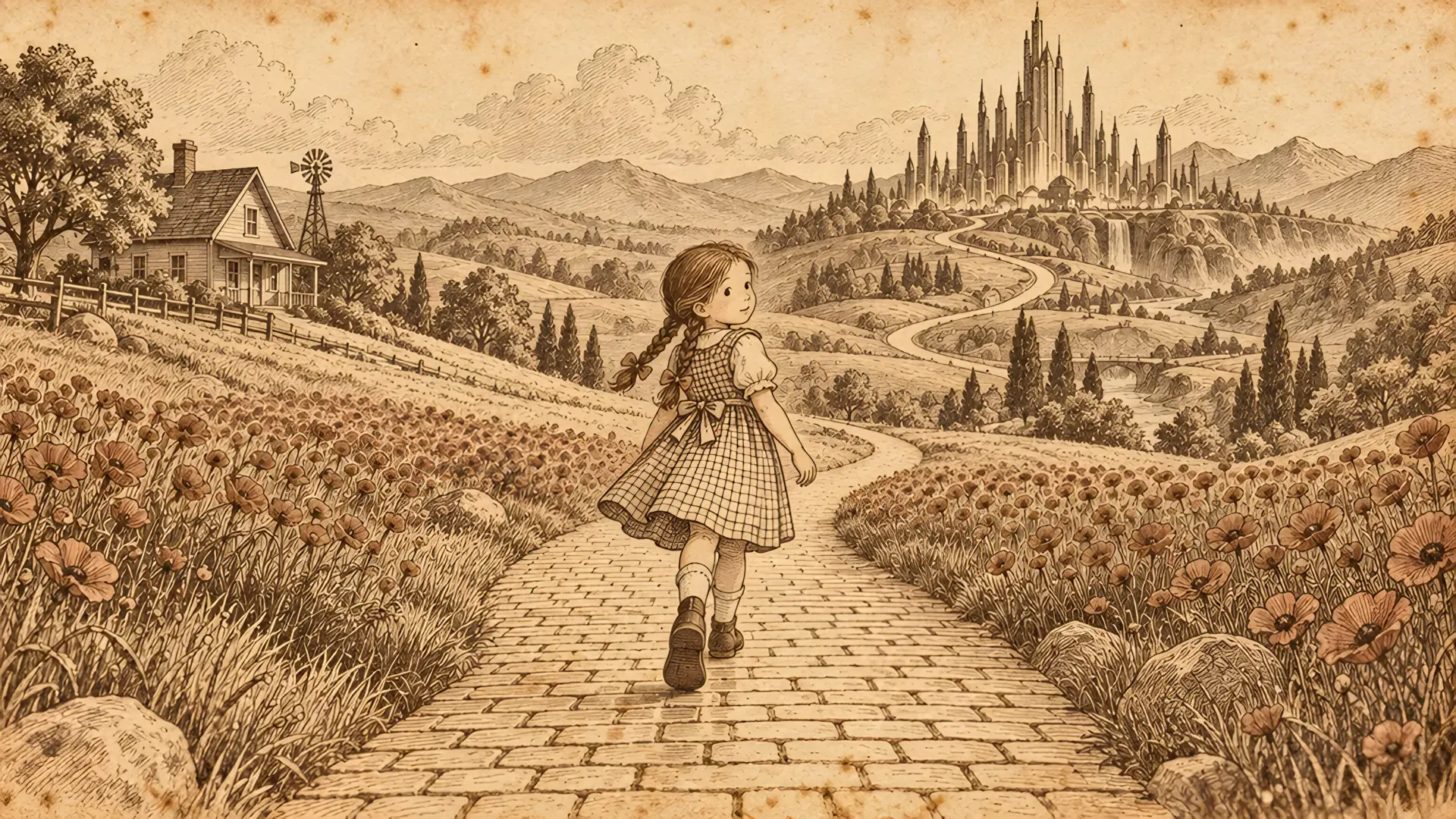
Our counting book, The Golden Road, puts these ideas into a story. Each counting page has one more thing to count than the page before: three spins of the house, four Munchkins, five golden bricks, and on up to the eleven green towers of the Emerald City. The parent’s page at the back suggests touching one shape for each number you say, which is one-to-one, then asking “So how many?”, which is cardinality. The book is too new to have a study of its own, but each of those moves is one the studies above describe.

On the last page the friends lie on a hill under the night sky, and the stars come out, twelve of them. The check on the parent’s page asks Wynn’s question: can your child count the twelve stars, one touch each, and say “twelve” when you ask how many, without counting again?
A yes is a good sign; a child who starts again from one is still on the way, which is normal. But “how many” can be bluffed, so follow it with the harder question from earlier: “Can you show me five of them?” A child who points to five stars and stops has it.
The sample spread on our home page is a little different: it has seven stars, the five of the Southern Cross and its two Pointers, and by happy coincidence seven is exactly where Grade R’s second-term range stops.
Five counting games for tonight
Children vary widely, and the ages in these studies are averages from small groups. If you are worried about a child in Grade R, their teacher watches them count every day and is the best person to ask first. When counting feels easy, number bonds are the next step: seeing that ten is seven and three.
Sources
- Wynn, K. (1990). Children’s understanding of counting. Cognition, 36(2), 155–193. doi.org/10.1016/0010-0277(90)90003-3
- Sarnecka, B. W., & Carey, S. (2008). How counting represents number: What children must learn and when they learn it. Cognition, 108(3), 662–674. doi.org/10.1016/j.cognition.2008.05.007
- Gelman, R., & Gallistel, C. R. (1978). The Child’s Understanding of Number. Cambridge, MA: Harvard University Press.
- Gelman, R., & Meck, E. (1983). Preschoolers’ counting: Principles before skill. Cognition, 13(3), 343–359. doi.org/10.1016/0010-0277(83)90014-8
- Kaufman, E. L., Lord, M. W., Reese, T. W., & Volkmann, J. (1949). The discrimination of visual number. American Journal of Psychology, 62(4), 498–525. pubmed.ncbi.nlm.nih.gov/15392567
- Clements, D. H. (1999). Subitizing: What is it? Why teach it? Teaching Children Mathematics, 5(7), 400–405. doi.org/10.5951/tcm.5.7.0400
- Levine, S. C., Suriyakham, L. W., Rowe, M. L., Huttenlocher, J., & Gunderson, E. A. (2010). What counts in the development of young children’s number knowledge? Developmental Psychology, 46(5), 1309–1319. doi.org/10.1037/a0019671
- Gunderson, E. A., & Levine, S. C. (2011). Some types of parent number talk count more than others. Developmental Science, 14(5), 1021–1032. doi.org/10.1111/j.1467-7687.2011.01050.x
- Siegler, R. S., & Ramani, G. B. (2008). Playing linear numerical board games promotes low-income children’s numerical development. Developmental Science, 11(5), 655–661. doi.org/10.1111/j.1467-7687.2008.00714.x
- Ramani, G. B., & Siegler, R. S. (2008). Promoting broad and stable improvements in low-income children’s numerical knowledge through playing number board games. Child Development, 79(2), 375–394. doi.org/10.1111/j.1467-8624.2007.01131.x
- Purpura, D. J., Napoli, A. R., Wehrspann, E. A., & Gold, Z. S. (2017). Causal connections between mathematical language and mathematical knowledge: A dialogic reading intervention. Journal of Research on Educational Effectiveness, 10(1), 116–137. doi.org/10.1080/19345747.2016.1204639
- Giese, S., Pettersson Gelander, G., Cook, C., Carnegie, T., Tredoux, C., Dawes, A., Biersteker, L., Beukes, S., Pahla, Z., & Kika-Mistry, J. (2025). Thrive by Five Index 2024: National Findings. Cape Town: DataDrive2030 (survey led by the Department of Basic Education). thrivebyfive.co.za (PDF)
- Department of Basic Education (2011). Curriculum and Assessment Policy Statement (CAPS): Mathematics, Grade R. Pretoria: DBE, pp. 8, 19, 41 and 44. education.gov.za (PDF)
- Department of Basic Education (2015). The South African National Curriculum Framework for Children from Birth to Four. Pretoria: DBE, pp. 51–52. education.gov.za (PDF)