Peter and Wendy, 1911
Second to the right, and straight on till morning
A boy who wouldn’t grow up, a hospital that still earns from him, and a retelling in which your child flies over Cape Town at night and learns to say how they feel.
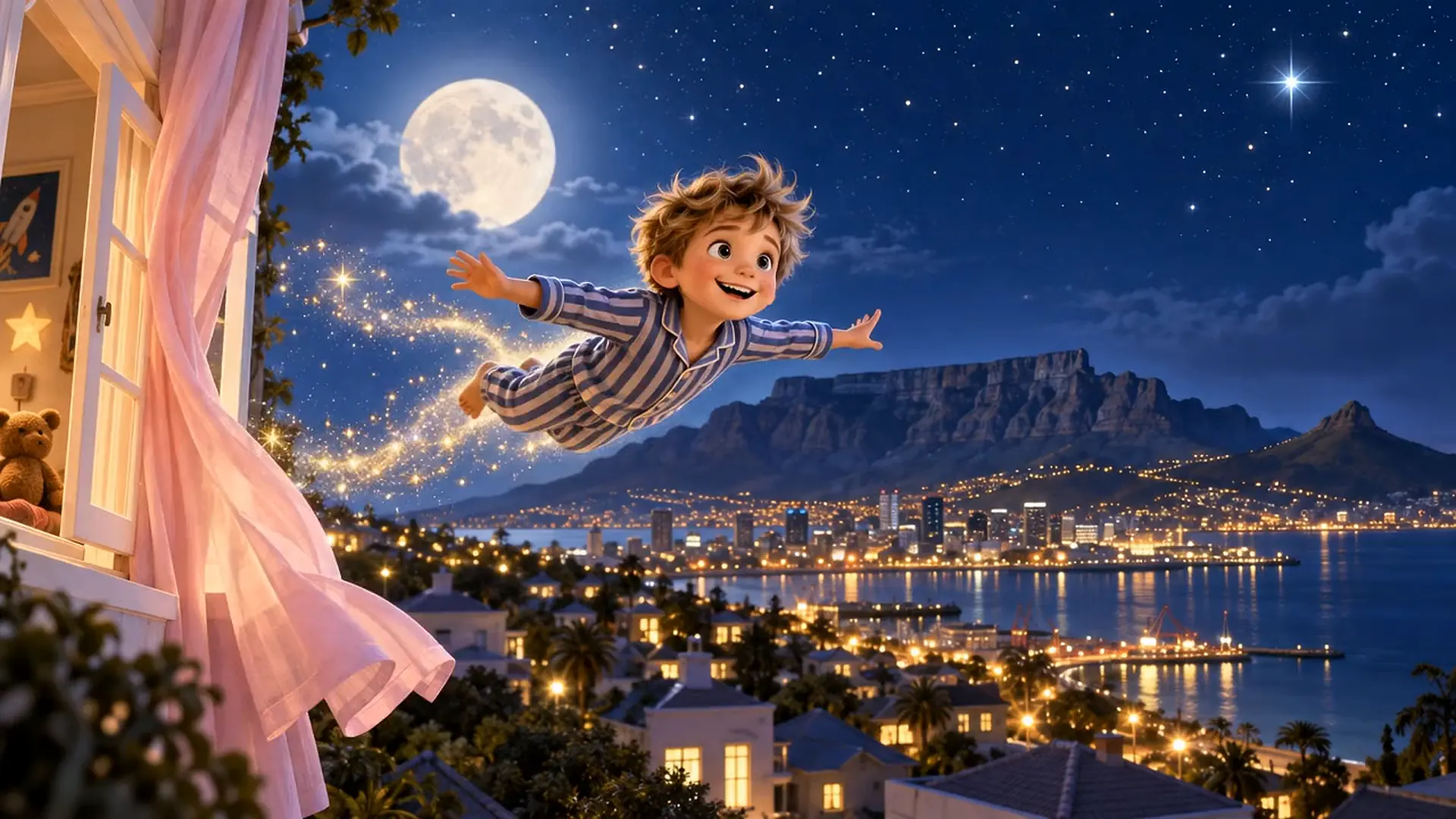
Peter Pan’s famous directions have no star in them. In J. M. Barrie’s novel he gives his address as “Second to the right, and then straight on till morning”,1 and the star most of us remember came later, from the screen. Barrie’s boy began in a novel for adults, and his story runs all the way to a London children’s hospital that still earns from him. In our personalised Peter Pan book, Second to the Right, your child flies over Table Mountain at night and practises saying how they feel.
What did Barrie actually write?
The directions come in chapter three of Peter and Wendy (1911), and Wendy’s reply is the one any parent would give:
“Second to the right,” said Peter, “and then straight on till morning.”
“What a funny address!”
A chapter later, Barrie repeats them in a shorter form, “Second to the right, and straight on till morning”, and then pulls the rug out. Even birds, he writes, “carrying maps and consulting them at windy corners, could not have sighted it with these instructions. Peter, you see, just said anything that came into his head.”1
Our book keeps Barrie’s shorter form, and no star. As we read the law, his novel is free to retell in South Africa, while the films that came later, their songs and their Tinker Bell, belong to someone else. (The bright star in our picture at the top of this page is just a star; nobody in our book steers by it.)
Where did Peter Pan come from?
Peter was born three times. He first appeared in 1902, in The Little White Bird, a novel for adults.2 He became famous on the stage, in a play that opened at the Duke of York’s Theatre in London on 27 December 1904.3 The first Peter, standard references say, was an actress, Nina Boucicault. Only in 1911 did the play become the novel Peter and Wendy, the book most of us mean by Peter Pan.
The novel opens with one of the great first lines in children’s books, then a moment every parent knows:
All children, except one, grow up. … One day when she was two years old she was playing in a garden, and she plucked another flower and ran with it to her mother. I suppose she must have looked rather delightful, for Mrs. Darling put her hand to her heart and cried, “Oh, why can’t you remain like this for ever!”
That is much of the book in a paragraph: the ache of a parent watching a child grow, and a boy who refuses to.
J. R. R. Tolkien, in his essay “On Fairy-Stories” (first given as a lecture at the University of St Andrews in March 1939), argued that children are meant to grow up.5 Our retelling quietly takes his side: your child flies to Neverland, and then chooses to come home.
Who owns Peter Pan now?
Barrie kept giving Peter away. On 1 May 1912 a bronze Peter by Sir George Frampton was placed in Kensington Gardens, the plaque says, as his gift.6 The bigger gift came in 1929, when Great Ormond Street Hospital in London asked him to help it buy land for a new wing. He turned the committee down, but said he “hoped to find another way to help”, and about two months later he gave the hospital all his rights in Peter Pan.7
At his wish, the hospital has never said how much the boy has raised for it. The gift outlived the copyright. UK copyright in the play expired at the end of 1987, and Parliament wrote a one-of-a-kind clause into the Copyright, Designs and Patents Act 1988: the hospital’s charity is entitled to royalties from the play and its adaptations, in perpetuity.7, 8 It applies in the UK only.
In South Africa the rule is simpler. Our Copyright Act protects a literary work for the author’s life plus fifty years from the end of the year in which the author dies.9 Barrie died on 19 June 1937, so on that rule Peter and Wendy, published in his lifetime, entered South Africa’s public domain on 1 January 1988, the morning after the play’s UK copyright ran out. (That’s our reading of the Act, not legal advice.)
What happens in Second to the Right?
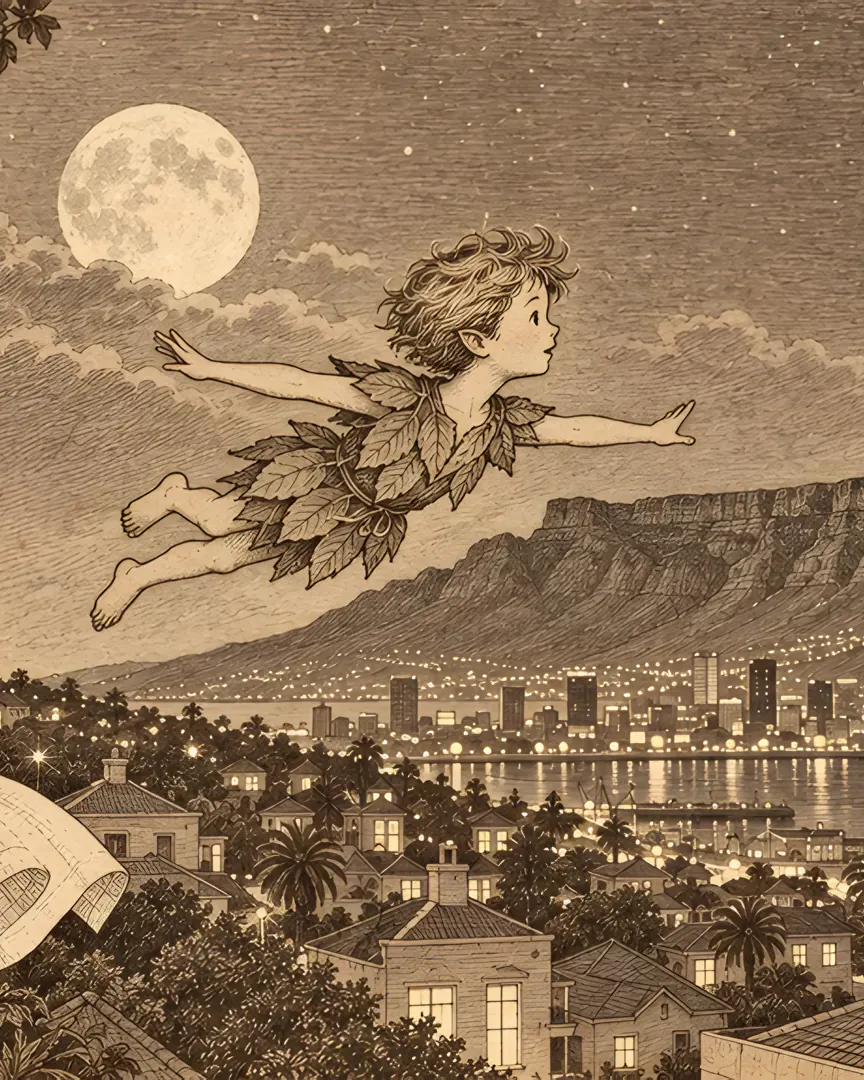
Our retelling begins in a house at the foot of Table Mountain, just after lights out. The dark is “very big”, and the hero, your child (Liam, in our sample), whispers the book’s first feeling: “I feel scared.” Then the window blows open, in flies “a boy dressed in leaves, a boy who never grew up”, and Peter teaches Liam a refrain: Name it, say it, breathe it out. One brave breath and a sprinkle of fairy dust later, Liam is out over the rooftops, where “The cable car was fast asleep on its wire. Lion’s Head was fast asleep too.”
Then the feelings come, one after another. A cheeky mermaid splashes Liam, who feels cross, breathes, and splashes right back. Little Tootles, one of the Lost Boys, misses his mum, and Liam asks him the book’s best question: “Can you name it?”
A crocodile that has swallowed a clock floats up, tick-tock; Liam names his fear, breathes, and the crocodile blinks a slow, sleepy blink and drifts off. Even Peter, who says he never feels anything, admits very quietly that he feels a bit sad. Then Liam, homesick, chooses to fly home.


Across twelve spreads the book names a dozen feelings, from scared and cross to loved, proud and sleepy, and treats none of them as a bad one. Nor does the last page pretend the fear has gone: “The dark was still very big.” But now Liam knows what to do with it.
What does it practise?
This book’s one skill is saying how you feel, chosen with South Africa’s curriculum as a reference (how we build each book is on our home page). In the first term of Grade R, CAPS Life Skills lists “how to express what I feel”.10 Before school, the national framework for children from birth to four asks adults to “Help children to put feelings into words”.11
In Grade 2, the six-hour Life Skills topic “Life at night” covers “get ready for bed, read and tell stories, sleep and dream”: this book’s whole territory. By Grade 3 the feelings topic names “anger, fear, worry, loneliness”, with a teaching note that could describe a picture book: “Use pictures, stories, rhymes, puppets and masks”.10 There is more in our guide to helping children name their feelings, and in what children learn in Grade R.
CAPS is our reference; the Department of Basic Education doesn’t endorse us.
Does naming a feeling really help?
In adults, studies suggest it does; in children, the evidence is promising but indirect. In 2007, Lieberman and his colleagues showed 30 adults, aged 18 to 36, emotional faces in a brain scanner. Picking a word for the emotion, such as “angry” or “scared”, reduced the response of the amygdala, part of the brain’s alarm system, more than picking a name to fit the face’s gender.12 Parenting experts turned this into “name it to tame it”, but these were adults looking at photographs, not four-year-olds in the dark.
For children, the evidence is mostly about understanding emotions, and a 2010 review of many studies found its links with getting on with others “relatively consistent yet modest”.13 Our refrain adds a breath after the name, because a child who has named a feeling still needs something to do with it. That breath is our own design, in a book too new to have been tested; the naming rests on research like this, limits and all. The studies in full, the questions that work best at bedtime and when to ask for help are in our guide to helping children name their feelings.
Is it too frightening for bedtime?
It is made not to be: moonlit blues, warm gold and a crocodile who is mostly sleepy. And fear at bedtime isn’t something a story puts into a child. As G. K. Chesterton put it in 1909, “Fairy tales do not give the child his first idea of bogey”; what a good tale provides is “a St. George to kill the dragon”.14
His whole argument, and a famous shorter version that isn’t in his essay at all, are in why fairy tales still matter. Our book has no dragon, only a dark room that stays big and a child who finds a way to be brave in it. Its parent page puts it plainly: “Night-time fears are a normal part of growing up and usually pass; if they are intense, last for weeks or affect the daytime, talk to your clinic nurse or GP.”
Who is it for?
We wrote Second to the Right for children of about three to seven: one who has started to worry about the dark, one starting Grade R, where feelings are on the timetable in the first term (see our gifts for starting school), or a young Capetonian who will spot the sleeping cable car. It is one of the five classics we retell, and its dedication says the rest: “For Liam, who can feel all sorts of things, and say every one out loud.”
Sources
- Barrie, J. M. (1911). Peter and Wendy. London: Hodder & Stoughton. Chapters I, III and IV. Project Gutenberg eBook #16. gutenberg.org/ebooks/16
- Barrie, J. M. (1902). The Little White Bird. Project Gutenberg eBook #1376. gutenberg.org/ebooks/1376
- London Museum. Duke of York’s Theatre printed ephemera, 1904 (the programme of the first performance of Peter Pan, 27 December 1904). londonmuseum.org.uk
- The Straight Dope. “Was the name Wendy invented for the book Peter Pan?” straightdope.com; American Name Society. “Peter Pan gave Wendy wings, but the name has fallen back down to earth”. americannamesociety.org
- The Tolkien Estate. On Fairy-stories. tolkienestate.com
- London Remembers. “Peter Pan in Kensington Gardens” (the plaque’s wording). londonremembers.com
- GOSH Children’s Charity. “The history of Peter Pan and Great Ormond Street”. gosh.org
- Copyright, Designs and Patents Act 1988 (UK), Schedule 6: Provisions for the benefit of the Hospital for Sick Children. legislation.gov.uk
- Copyright Act 98 of 1978 (South Africa), section 3(2)(a). acts.co.za. Our reading of the Act, not legal advice.
- Department of Basic Education (2011). Curriculum and Assessment Policy Statement (CAPS): Life Skills, Foundation Phase, Grades R–3. Pretoria: DBE. Grade R Term 1 (p. 15), Grade 2 Term 4 (p. 45), Grade 3 Term 1 (p. 54). education.gov.za (PDF)
- Department of Basic Education (2015). The South African National Curriculum Framework for Children from Birth to Four. Pretoria: DBE. Well-being, Towards Grade R (p. 30). education.gov.za (PDF)
- Lieberman, M. D., Eisenberger, N. I., Crockett, M. J., Tom, S. M., Pfeifer, J. H., & Way, B. M. (2007). Putting feelings into words: Affect labeling disrupts amygdala activity in response to affective stimuli. Psychological Science, 18(5), 421–428. doi.org/10.1111/j.1467-9280.2007.01916.x
- Trentacosta, C. J., & Fine, S. E. (2010). Emotion knowledge, social competence, and behavior problems in childhood and adolescence: A meta-analytic review. Social Development, 19(1), 1–29. doi.org/10.1111/j.1467-9507.2009.00543.x
- Chesterton, G. K. (1909). The Red Angel. In Tremendous Trifles. London: Methuen. Project Gutenberg eBook #8092. gutenberg.org/ebooks/8092