An original story
Their own adventure
For the child who only wants dinosaurs: an original story about the thing they love, set somewhere they know, with one real skill inside.
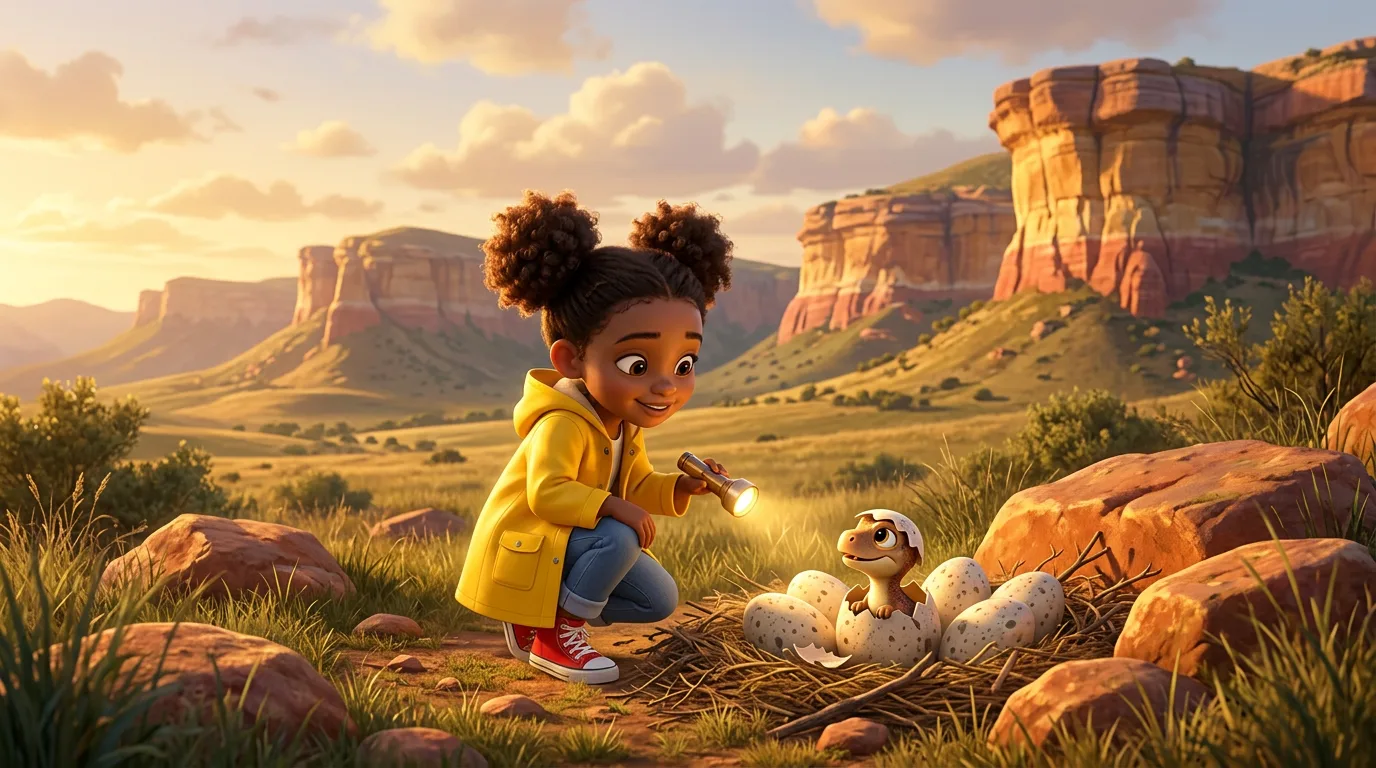
The oldest known dinosaur nesting site on Earth is in the Free State. That is exactly the kind of thing a dinosaur-mad child should know, and the kind of place we set their own adventure: a personalised book we write from scratch around whatever they can’t stop talking about, be it dinosaurs, space, rugby, ballet, animals or something we haven’t thought of yet.
How does a theme book work?
You tell us what they love. In the catalogue on our home page, pick one of five themes (dinosaurs, space, rugby, ballet or animals) or type in something else entirely: trains, netball, mermaids. Then tell us your story idea when we’re in touch about the book, and we write an original story around it, set somewhere they know, from the Karoo to your own street.
Everything else works as it does for the classics. You upload one to three clear, everyday photos, and we draw your child into the pictures to look like themselves. We send you the cover and a spread before anything is printed, and there is nothing to pay until you’ve seen the cover. The book can be in English, isiZulu, isiXhosa, Afrikaans or Sesotho.
Does a theme book still practise a skill?
Yes. A theme book is not a holiday from learning. Like every book we make, it practises one skill, chosen for your child’s age and chosen with you. The skill is part of the plot, so it comes back on several spreads before a small check at the end, and a page at the back gives you things to try as you read. We haven’t tested the books themselves, which are new, but that way of practising, coming back to a skill again and again, is well studied.
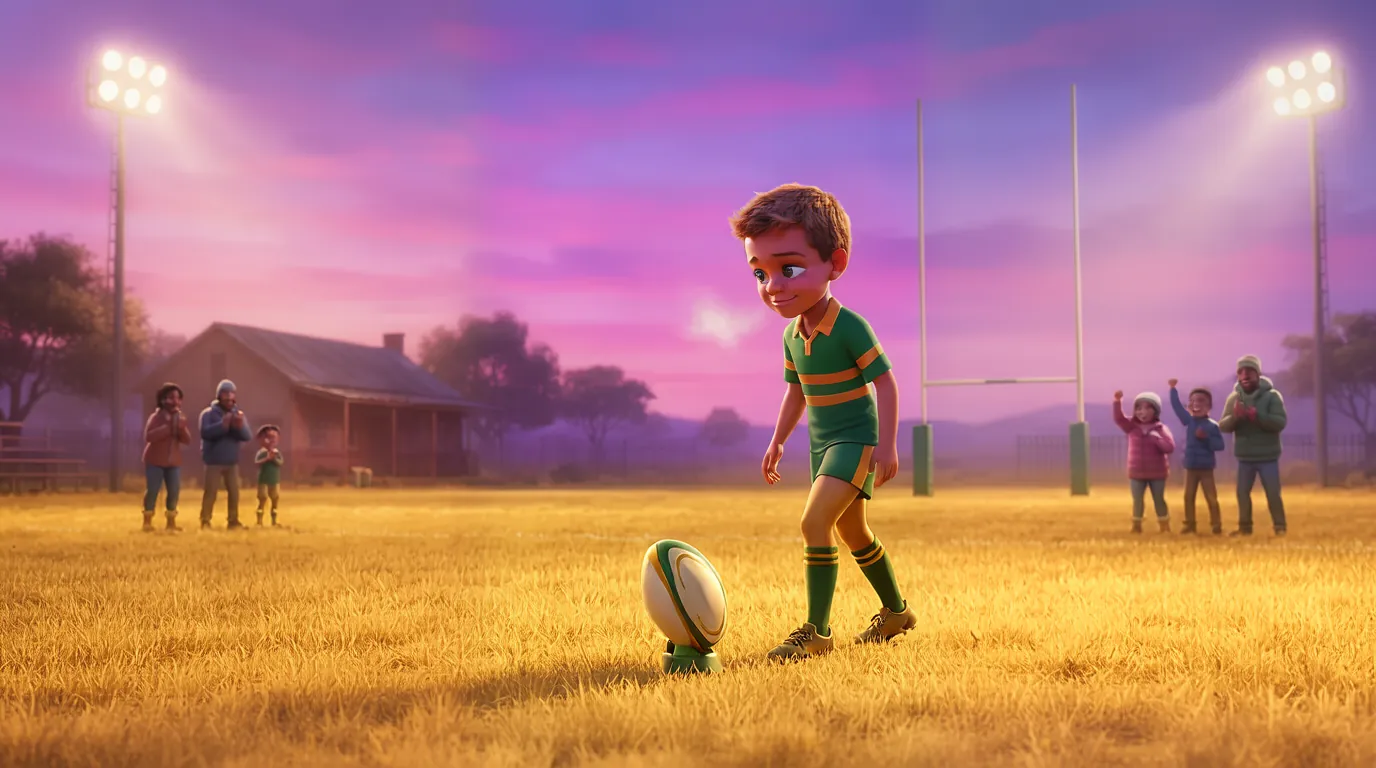
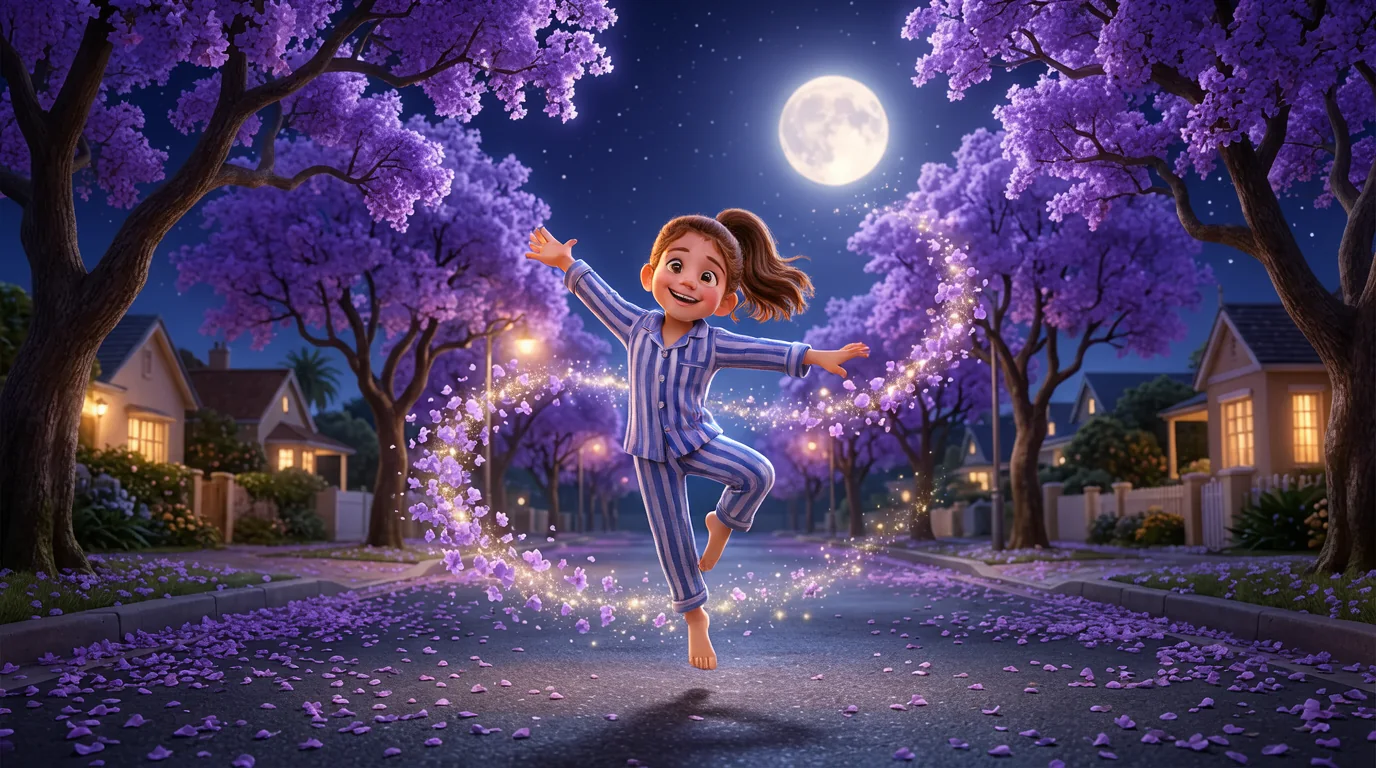
The examples on our home page show the idea. A dinosaur book set in the Golden Gate Highlands practises counting to ten. A space book at Sutherland practises staying calm in the dark; a rugby book under Highveld floodlights, a calm-down routine; a ballet book in Pretoria’s jacaranda season, counting the beat; an animal book on a night drive in the Kruger, counting in twos. The theme is the hook. The skill is the point. To see which skills suit which school year, start with Learning.
From Grade R up, we choose the skill with South Africa’s curriculum as our guide. CAPS is our reference; the Department of Basic Education doesn’t endorse us.
Dinosaurs: a nursery in the Free State
At Rooidraai, in Golden Gate Highlands National Park, palaeontologists found at least ten clutches of eggs laid by Massospondylus, a dinosaur of the Early Jurassic, at the same spot, over and over.1 It is the oldest known dinosaur nesting site, older than any similar site by more than 100 million years. The most complete clutch holds at least 34 eggs, which is a lot of counting for a small person with a torch.
The tiny footprints are the best part. Hatchlings stayed at the nest long enough for their feet to at least double in size.1 Embryos described in 2005 show babies that walked on all fours and had no proper teeth, so they may have needed their parents’ care, while the adults could walk on two legs.2 Babies on all fours, grown-ups on two: a dinosaur family your child may find familiar.
Also in the Free State, from the area around Clarens, comes a giant. In 2018 Wits palaeontologists gave the 12-tonne dinosaur a Sesotho name, Ledumahadi mafube, “a giant thunderclap at dawn”. It lived nearly 200 million years ago and, its discoverers say, was the largest land animal alive in its time.3
Space: the Karoo’s giant telescopes
Near Sutherland, in the Karoo, stands SALT, the Southern African Large Telescope. Its main mirror is made of 91 hexagons, each a metre across, which together form an 11-metre mirror, the largest in the Southern Hemisphere.4 Ninety-one is a good number for a child who is learning to count past ten.
Ninety kilometres outside Carnarvon, in the Northern Cape, stand the 64 dishes of MeerKAT, a radio telescope that will become part of the Square Kilometre Array’s mid-frequency telescope: 197 dishes in the Karoo, up to 150 km apart.5, 6 In 2019 MeerKAT revealed a pair of giant radio bubbles at the centre of our galaxy, about 1,400 light years tall, which the astronomers argue were blown by a single energetic event at the galaxy’s heart.7
On our home page, the sample spread from The Golden Road, our retelling of Oz, asks a child to count seven stars: the five of the Southern Cross, then its two Pointers. How to find south with them, and why the brighter Pointer is famous, is on the page about The Wizard of Oz and our Golden Road, so a space-mad child has a way in there too.
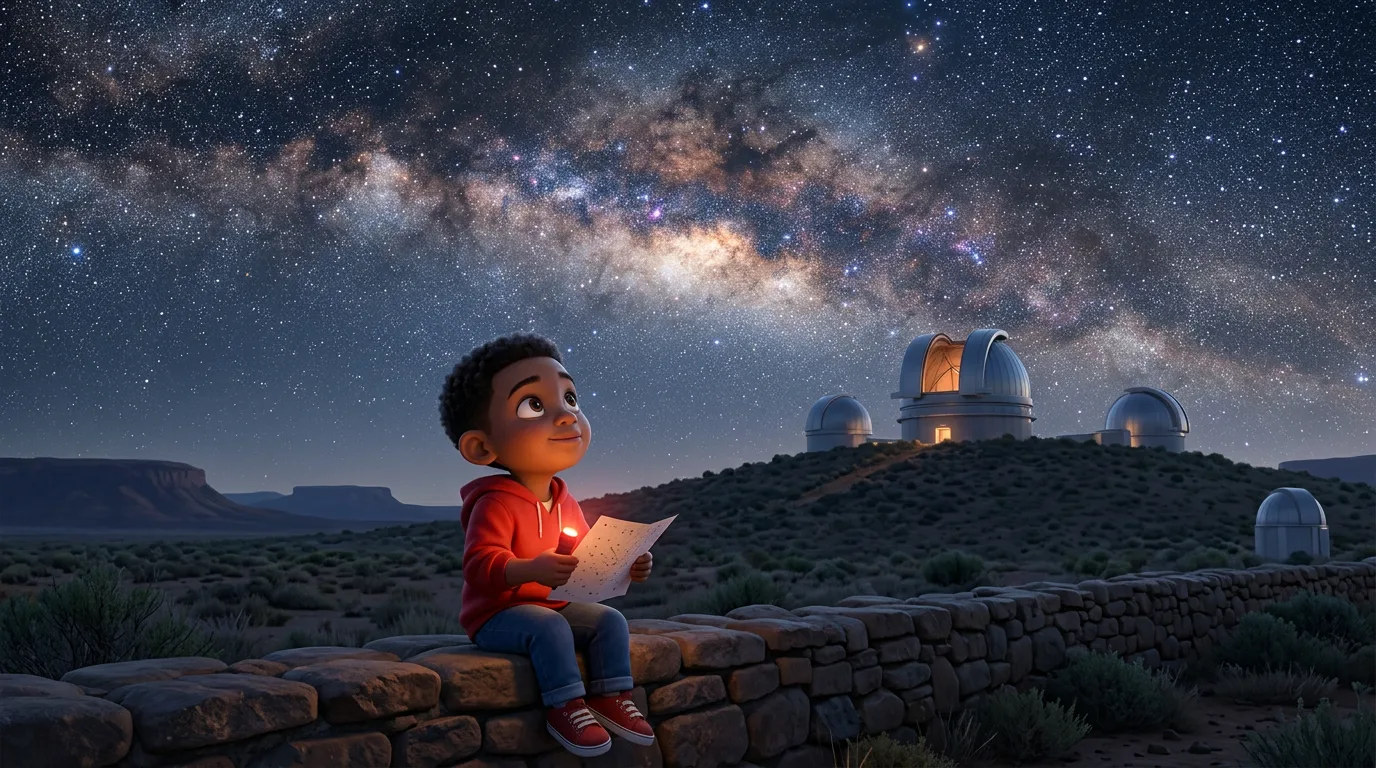
The space example on our home page, Sipho at Sutherland, practises staying calm in the dark. It is the first thing every stargazer has to learn: the best of the sky only shows itself once the lights are off.
Rugby: from Green Point to four World Cups
The first recorded rugby-style match in South Africa was played at Green Point, Cape Town, in August 1862, between a military side and a civilian one.8 Canon George Ogilvie, the headmaster of Bishops, organised it, and the game was closer to the football played at Winchester College than to rugby today.9 The touring team of 1906 and 1907 was the first to be called the Springboks, an English version of the players’ own Afrikaans nickname, the Springbokken. That team was all white, and the game’s history here is bound up with segregation: the South African Coloured Rugby Football Board was founded in 1897.9
South Africa has since won the Rugby World Cup a record four times, in 1995, 2007, 2019 and 2023, the last by 12 points to 11 against New Zealand at the Stade de France.10 The moment before a kick, with everyone watching, is a fine place for a story to practise a calm-down routine.
Ballet: from District Six and Rustenburg to the world’s stages
Johaar Mosaval was born in District Six in 1928 and became the first black South African to reach senior principal dancer at the Royal Ballet, the highest rank in the profession; in 2019 he received the Order of Ikhamanga in gold.11, 12 John Cranko, born in Rustenburg in 1927, became director of the Stuttgart Ballet in 1961 and created Onegin in 1965.13
At home, Cape Town City Ballet grew from the UCT Ballet Company, which Dulcie Howes founded in the 1930s. Joburg Ballet began in 2001, when six dancers retrenched by PACT Ballet formed South African Ballet Theatre; it took its present name in 2013.14, 15 The ballet example on our home page practises counting the beat, which any small dancer twirling in the lounge can start on tonight.
Animals: the Kruger at 100
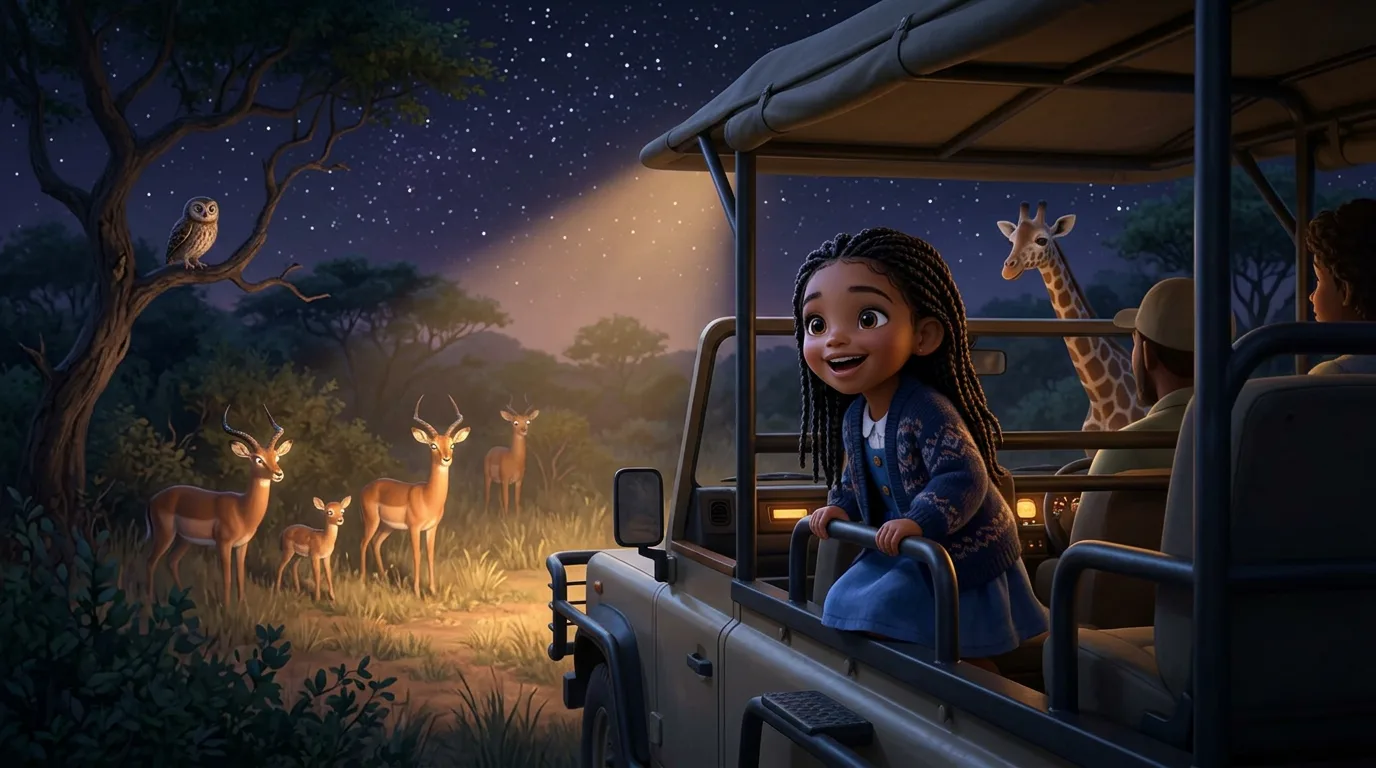
Kruger National Park turned 100 in 2026: the country marked its centenary on 31 May. The National Parks Act of 1926 created it by joining the Sabie and Shingwedzi game reserves, and its roots go back to 1898, when the South African Republic proclaimed the Sabie Game Reserve between the Sabie and Crocodile rivers.16 It covers about 19,485 square kilometres, nearly two million hectares, with nearly 150 kinds of mammal and more than 500 kinds of bird.17
On a night drive, the eyes that shine back in the spotlight come in pairs, which makes them a natural way to count in twos.
Whatever the theme, why a story that stars them may help, and what the research doesn’t show, is in the science of starring. And if they turn out to want a classic after all, all five are on the stories page.
Sources
- Reisz, R. R., Evans, D. C., Roberts, E. M., Sues, H.-D., & Yates, A. M. (2012). Oldest known dinosaurian nesting site and reproductive biology of the Early Jurassic sauropodomorph Massospondylus. PNAS, 109(7), 2428–2433. doi.org/10.1073/pnas.1109385109
- Reisz, R. R., Scott, D., Sues, H.-D., Evans, D. C., & Raath, M. A. (2005). Embryos of an Early Jurassic prosauropod dinosaur and their evolutionary significance. Science, 309(5735), 761–764. doi.org/10.1126/science.1114942
- University of the Witwatersrand (September 2018). Ledumahadi mafube: South Africa’s new Jurassic giant. wits.ac.za
- Southern African Large Telescope. The telescope. salt.ac.za/telescope
- South African Radio Astronomy Observatory. About MeerKAT. sarao.ac.za
- SKA Observatory. SKA-Mid. skao.int
- Heywood, I., Camilo, F., Cotton, W. D., Yusef-Zadeh, F., Abbott, T. D., et al. (2019). Inflation of 430-parsec bipolar radio bubbles in the Galactic Centre by an energetic event. Nature, 573(7773), 235–237. doi.org/10.1038/s41586-019-1532-5
- South African History Online. First rugby match played in SA. sahistory.org.za
- South African History Online. Early history of rugby in South Africa. sahistory.org.za
- Guinness World Records. Most Rugby Union World Cup wins. guinnessworldrecords.com
- The Presidency, South African Government (17 August 2023). President Cyril Ramaphosa mourns passing of dance pioneer Johaar Mosaval. gov.za
- Encyclopaedia of South African Theatre, Film, Media and Performance (ESAT), Stellenbosch University. Johaar Mosaval. esat.sun.ac.za
- The Kennedy Center. Stuttgart Ballet. kennedy-center.org
- ESAT, Stellenbosch University. UCT Ballet Company. esat.sun.ac.za
- ESAT, Stellenbosch University. South African Ballet Theatre. esat.sun.ac.za
- Brand South Africa (5 June 2026). Kruger at 100: celebrating a legacy of life, hope and conservation. brandsouthafrica.com
- South African National Parks. Kruger National Park. sanparks.org